[Transcript]
Hello, and welcome to America’s First Ladies. I’m your host, Risa Weaver-Enion.
Episode 4.14 Life After James
We left off last week in February 1835. James and Dolley had just hosted British writer Harriet Martineau for three days at Montpelier, where she learned everything she could from the mind of James Madison.
In April 1835, James made his will, leaving generous bequests to colleges, universities, charitable institutions, and his many nieces and nephews. Everything else was to go to Dolley. The one thing he did not do in his will was free the Montpelier slaves. He merely said that none should be sold without their consent, as well as Dolley’s consent. It was the ultimate cop-out from the man who claimed he had always wanted to find a way to end slavery in America.
James’s physical health continued to deteriorate, but his mind stayed sharp. His long-time enslaved valet, Paul Jennings, who had been with him in the President’s House, later recalled that “for six months before his death, he was unable to walk, and spent most of his time reclining on a couch. [But his mind] was bright and with his numerous visitors he talked with as much animation and strength of voice as I ever heard him in his best days.”
The last visitor to record his observations of James was former Congressman Charles Ingersoll, who visited in May 1836. Ingersoll wrote that James’s “understanding…[was] as bright as ever; his intelligence, recollections, discriminations, and philosophy all delightfully instructive. … A purer, brighter, juster spirit has seldom existed.”
But apparently the visit exhausted James because Dolley wrote that it had left him “unable to write or even to exert his thoughts without oppressive fatigue.”
On June 28, James’s valet Paul Jennings gave him his daily shave, as he had been doing for the past 16 years. Another longtime slave, Sukey, who was practically as old as James, brought him his breakfast. James’s niece Nelly came to visit him while he breakfasted, and when she noticed he was having trouble swallowing, she asked him what was wrong. He replied, “Nothing more than a change of mind, my dear.” And then, in Paul Jennings’s words, “his head instantly dropped, and he ceased breathing as quietly as the snuff of a candle goes out.”
James Madison was 85 years old when he died, making him older at his death than Jefferson (who died at 83) and Washington (who died at 67), but he didn’t make it as long as Adams, who had died at the age of 91. Because his final decline came so close to the Fourth of July, several of his friends suggested that he take medicines to prolong his life so that he could die on the 60th anniversary of the approval of the Declaration of Indpendence, much like Jefferson and Adams had died on the 50th anniversary. James declined and let nature take its course.
Before his death, he had written a note intended for publication after he died. It was called Advice to My Country, and his parting words to the nation he had served for so long were:
“The advice nearest to my heart and deepest in my convictions is that the Union of the States be cherished and perpetuated. Let the open enemy to it be regarded as a Pandora with her box opened; and the disguised one, as the Serpent creeping with his deadly wiles into Paradise.”
James was buried the day after he died in the family plot at Montpelier, with Dolley, friends and family from all over the county, and the Montpelier slaves making up the funeral procession. Because they had known for some time that James was nearing his end, he and Dolley had had ample time to prepare. James had laid out detailed plans for her to follow in running the plantation. And her niece, Anna Payne, daughter of Dolley’s brother John, came to live with Dolley as her companion and secretary.
A month after James’s death, Dolley wrote her lifelong friend Eliza Collins Lee, “Indeed I have been as one in a troubled dream since my irreparable loss of him. … I owe his wishes, that I should be calm, and strive to live long after him.” Dolley was only 68 when she became a widow for the second time, so she knew she was likely to go on living without him for quite some time. Her sadness enveloped her for a little while—a visiting friend wrote, “the change was most sad. The house seemed utterly deserted. The great statesman, loving husband, kind master and attentive friend was gone. [We] seemed lost in the great desolate house.”
But Dolley had many responsibilities to keep her busy. Her niece Anna wrote, “She has at present and will have for some months so much important business to give her attention to that I hope when she has time to reflect on the past her distress will be so softened as in a measure to pass away.”
By 1838, Dolley was able to write to Margaret Bayard Smith that she “was involved in a variety of businesses, reading, writing, and flying about the house, garden and grove, straining my eyes to the height of my spirits, until they became inflamed, and frightened into idleness and to quietly sitting in drawing room with my kind connections and neighbors, sometimes like the ‘farmeress,’ and often acting the character from my rocking chair.”
You’d like to think that Dolley’s son Payne would have been some comfort to her after James’s death. He was quite the opposite. We haven’t talked about Payne in a while, so let’s catch you up on all his mis-deeds.
You’ll recall that he was sent to Europe with the peace commissioners in 1813. As Richard Côté writes in Strength and Honor: The Life of Dolley Madison, “During his two years of service as an attaché with the peace commission, he showed little interest in the proceedings of the commission, but great interest in the ballrooms. … In France, he kept company with royals and courtiers and flirted, danced, drank, and gambled himself into heavy debts, which Madison discreetly paid. When he returned to Washington, Payne’s parents hoped that he would find a good wife, settle down, cut back on his drinking, raise tobacco, and rear a proper family. Their prayers were not answered.”
Instead, he continued drinking, flirting, and gambling, racking up debts upon debts, which James and Dolley always paid. He was even thrown into debtor’s prison at least twice. After he was thrown in prison the second time, in 1830, Dolley wrote to her sister Anna, “My pride—my sensibility, & every feeling of my Soul is wounded. Yet we shall do something—what or when depends on Mr. Madison’s health, & strength, to do business—his anxiety, & wish to aid, & benefit Payne is as great as a Father’s—but his ability to command money in this country, is not greater than that of others.”
It appears that the Madisons paid out between $40,000 to $60,000 to cover Payne’s debts between 1813 and 1836. That’s in the neighborhood of a million dollars in today’s money.
In Bruce Chadwick’s description of Payne Todd in his book James & Dolley Madison: America’s First Power Couple, I hear some sociopathic tendencies, “Payne was impulsive; was a victim to roller-coaster highs and lows; was unable to complete simple tasks; had no regard for money; imposed on his parents and their friends endlessly; failed in all his romances; could not work for anyone else; had no direction in life; paid no attention to schedules or deadlines; and, everyone said, did not seem to have any genuine feelings of emotion toward people, not even toward his parents. Yet, at the same time, he was very good looking, bright, and charming; and was a marvelous conversationalist, a good dancer, and a dazzling young man.”
After Dolley and James returned to Montpelier in 1817, Payne looked like he might be ready to tame his wicked ways. He asked James to help him purchase 104 acres of land near Montpelier so he could live there and start a silkworm farm. Dolley paid $504 for the land in 1818 and signed it over to Payne. He built a house on the land and gave it the ridiculous name of Toddsberth. It won’t surprise you at all to hear that the silkworm business failed, despite bringing in a French silkworm expert to oversee their development.
Despite all his shortcomings, Dolley never saw the true Payne, and always believed his lies that he would settle down just as soon as such-and-such occurred. She kept trying to set him up with eligible women she knew, but the relationships never went anywhere, unsurprisingly. Some of Dolley’s blindness to Payne’s faults was because no one ever wanted to tell her how horrible her son really was. James paid many of Payne’s debts without telling Dolley about them, because he didn’t want her to worry. And the women Payne dated told her only that he was gallant and delightful, never that he was flighty and irresponsible. So Dolley persisted in completely misunderstanding her son’s true nature. And it would come back to bite her.
After James’s death, Dolley had her hands full trying to execute the terms of his will. He had left bequests of around $15,000 to various schools and charities, but there was no actual money to fulfill these bequests. She could barely pay daily expenses with the revenue generated by Montpelier. She foolishly decided to make Payne the manager of Montpelier so she could focus on selling James’s official papers to a publisher in either New York or Philadelphia. James had hoped she would be able to raise $100,000 with the sale.
Dolley reached out to friends with contacts in the publishing industry and set up a series of meetings. And then foolishly, once again, delegated those meetings to Payne, instead of an actual literary agent. Her friend James Paulding, who had connected her with a major publisher, wrote, “If you are acquainted with [Payne], you need not be told that he is the last man in the world to compass such a business.”
By the end of 1836, Payne had alienated every one of the publishers. Dolley was forced to write to President Andrew Jackson and ask him to recommend to Congress that it purchase James’s papers. She asked for $100,000, which Congress rejected outright. The government had paid only $25,000 for George Washington’s papers. Although, to be fair, that was several decades prior, and there probably weren’t as many in Washington’s collection.
In the end, Dolley and Congress agreed on a sum of $30,000 for three volumes of James’s papers. But it took more than two years for the transaction to be completed, and almost four years elapsed before they were actually published. After trying and failing again to get a publishing house interested in the fourth volume of James’s papers, Dolley turned to Congress again. They agreed to purchase the fourth volume for another $30,000.
But because everyone was worried that Payne would abscond with Dolley’s money, arrangements were made to pay the fee over a period of time instead of all at once. No less than the Secretary of the Treasury wrote, “Her son Todd is here playing the fool in high style as far as I can hear. It will never do to let him get hold of this money, or to have anything to do with it. The man is deranged, if he ever had any sense…what orders she has given her son I know not, but if she has given him any to pay her debts with it, [money] will certainly be squandered.”
All of this drama understandably made Dolley physically ill. She had had eye problems off and on throughout her life, and they returned during this period. Doctors, of course, tried leeches. Because that makes sense. The Philadelphia doctor who had successfully treated her knee all those years earlier sent her a lotion, but it didn’t help. John Payne wrote that “the inflammation around the eyes is a little abated, but not so the soreness and rawness, and the discharge is unchanged in consistence [sic], and perhaps increased in quantity, and the white balls are slightly inflamed; one more so than the other. The itching and burning sensations of the lids the same.” It sounds quite painful, and caused Dolley to cancel many social engagements.
None of the biographers bothers to say how this medical situation resolved itself, but I get the sense that it eventually did get better and that she wasn’t suffering this much the rest of her life. She eventually resumed her busy social calendar, so I’m assuming her eyes cleared up at some point.
Dolley had always felt like Montpelier was too secluded, and she had missed the society of Washington ever since the Madisons retired. Shortly after James’s death in 1836, she had written to Margaret Bayard Smith, “in truth, I am dissatisfied with the location of Montpelier, from which I can never separate myself entirely, when I think how happy I should be if it joined Washington, where I could see you always and my valued acquaintances also of that city.”
So in autumn 1837, she moved back to Washington. She moved into the home of her widowed brother-in-law, Richard Cutts. Through a round-about series of events, Dolley actually owned the house. Richard Cutts had built it when he married Dolley’s sister Anna, but he had fallen on hard times after the War of 1812 and eventually declared bankruptcy. In order to help him remain in the house, James paid off the debt, so he essentially held a mortgage on Richard’s house. When James died, it passed to Dolley. Richard Cutts no longer occupied the house, so Dolley asked the current tenant to relocate, and she moved in, along with her niece and companion, Anna Payne. (Remember, this is her brother John’s daughter. Not to be confused with her deceased sister, Anna Payne Cutts.)
As Richard Cote writes, “In Washington, [Dolley] was welcomed back like a long-lost friend and instantly was deluged with invitations to dinners, parties, and balls. Within a year, she had more social engagements than she could possibly handle. … Dolley, now turning seventy years old, was a full-blown Washington celebrity again.”
Dolley was surprised, but happy, to find that many of her old acquaintances were still there. Some of the same politicians were still in office; some of the same socialites were still throwing parties. One of her first visitors upon her return was former president and current Massachusetts senator, John Quincy Adams. Despite his father having been a Federalist, John Quincy Adams gradually turned from the Federalist to the Republican party, and had served as ambassador during Madison’s presidency. They had never been close political allies, but they had seen eye-to-eye on many things. Adams wrote of Dolley, “I had not seen her since 1809. The depredations of time are not so perceptible in her personal appearance as might be expected. She is a woman of placid appearance, equable temperament, and less susceptible of laceration of the scourges of the world abroad than most others.”
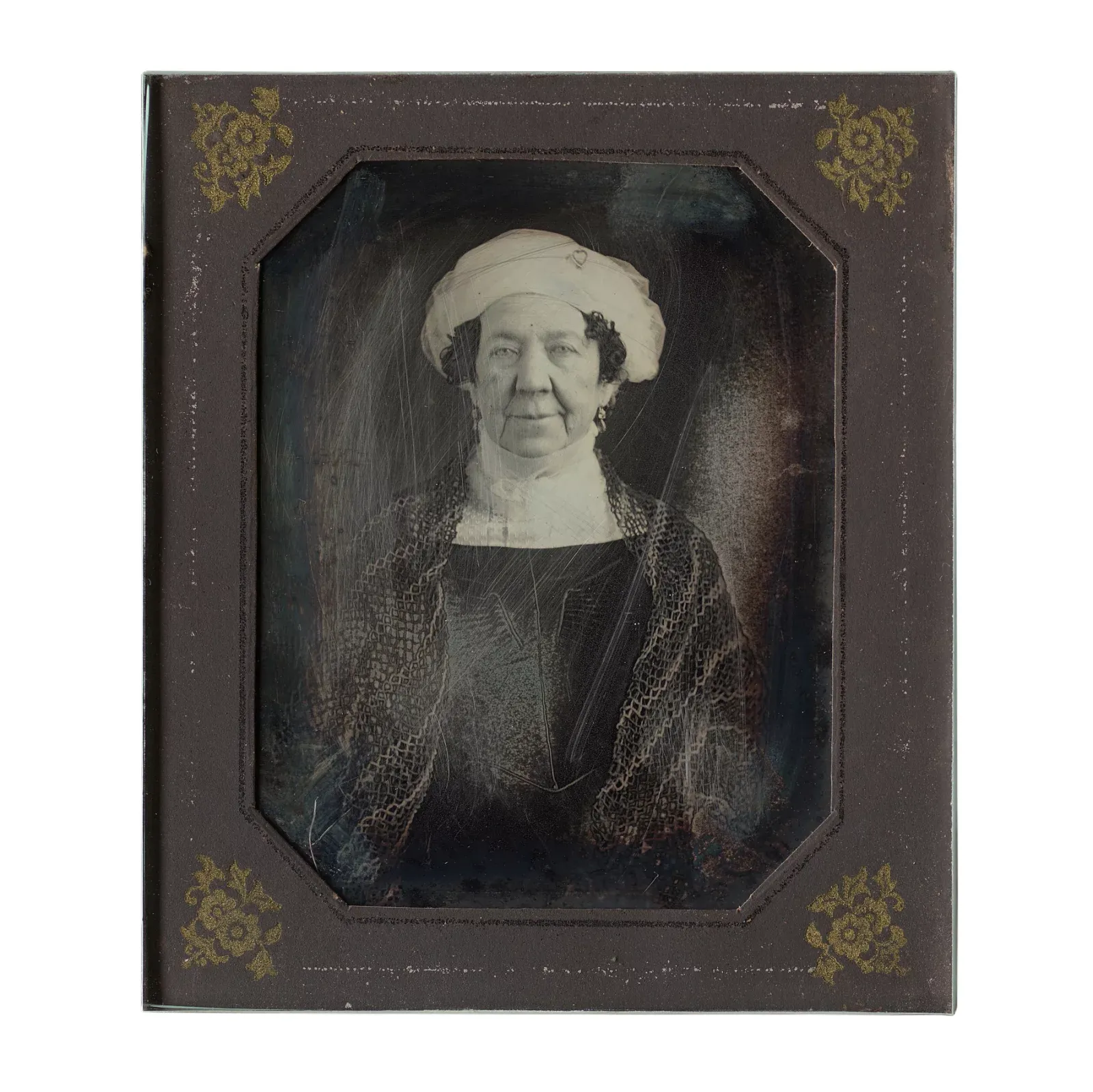
Dolley also never lost her keen fashion sense, or her desire to be one of the best-dressed women in the room. One of her grand-nieces described her outfit for one party: “Aunt Madison wore a purple velvet dress, with plain straight skirt amply gathered to a tight waist, cut low and filled in with soft tulle. Her pretty white throat was encircled by a lace cravat…thrown lightly over her shoulders was a little lace shawl or cape, as in her portrait…I thought her turban very wonderful, as I had never seen anyone else wear such a head-dress…her eyes were blue and laughed when she smiled and greeted her friends who seemed so glad to see her.”
During Martin Van Buren’s presidency (1837 to 1841) Dolley was a frequent guest at presidential soirees. In fact, she took one of her grand-nieces to a party at the President’s House where the girl met the president’s son, Andrew Van Buren. They were eventually married.
When John Tyler became president in 1841, he had no wife, so he asked his daughter-in-law to fill the First Lady role. She had no idea what to do, so she naturally turned to the most famous First Lady of all, Dolley Madison. Dolley trained Mrs. Tyler in everything she needed to know to be a successful presidential hostess. Daniel Webster joked to Dolley that she was “the only permanent power in Washington” after having played a prominent role in the Jefferson, Madison, Van Buren, and now Tyler administrations.
The fallout from a financial meltdown known as the Panic of 1837 sent Dolley into further financial straits, and she was forced to rent out the Cutts house in 1840 and 1841 and return to Montpelier. Payne had been doing his best to run the plantation into the ground, and it wasn’t even capable of sustaining itself, let alone paying for Dolley’s lifestyle and Payne’s. In 1841 Dolley re-wrote her will, putting all of her assets into a trust. It seems she may have finally realized that Payne did not know what he was doing, and she didn’t want him to have access to whatever assets might remain when she died.
By 1842, Dolley’s friends advised her that the only way she could avoid becoming penniless was to sell Montpelier. She found a buyer, Henry Moncure, who agreed to purchase the estate, including all the slaves, over a period of years. The sale was accelerated in 1844 when Dolley received a frantic note from one of the Montpelier slaves. Apparently, one of James’s brothers was trying to collect a $2000 debt that James owed him. He had gone to the county sheriff, and the sheriff had seized the slaves and was preparing to sell them to satisfy the debt. So instead, Dolley signed over Montpelier to Henry Moncure immediately, taking a loss on the property, but preventing the slaves from being seized and sold. As the property of Moncure, they were no longer eligible property to be sold to satisfy a debt of James Madison’s. The estate that had been in the Madison family for generations, and that James had prized above anything else, was gone.
As the 1840s progressed, Dolley was honored in a variety of ways. A medal was issued to commemorate a sea battle during the War of 1812. A number of foreign dignitaries and historical societies received copies of the medal, but only Dolley received one cast in silver—a sign of the respect still given to her for her efforts to save George Washington’s portrait and other important historical documents during the British attack.
In January 1844, the House of Representatives bestowed a unique honor on her. The resolution read: “Resolved, unanimously, that a committee be appointed on the part of the House to wait upon Mrs. Madison, and to assure her that, whenever it shall be her pleasure to visit the House, she be requested to take a seat within the Hall.” This put her on the level with sitting Congressmen, as opposed to visitors to the House, who sat in the gallery. It was the highest political compliment ever paid to a woman up to that point.
In February 1844, Dolley was present at what may or may not have been the first presidential assassination attempt. The U.S.S. Princeton was a recently commissioned Navy steamship. It was making a pleasure cruise on the Potomac with more than 400 people on board, including President John Tyler. Dolley was there as his guest. Also on board was the world’s largest naval gun, ironically named The Peacemaker. The gun was fired several times in the afternoon, much to everyone’s delight, and then they all descended below deck for lunch and refreshments.
After lunch, the ship’s captain went to fire the gun one more time. Something went dreadfully wrong, and the enormous gun exploded, killing six people, including the Secretary of State and Secretary of the Navy. Thankfully, Dolley was still below, as was President Tyler. Dolley was apparently so distressed by the close call that she refused to talk about the incident for the remainder of her life.
In May 1844, Samuel Morse made the first public demonstration of his invention, the telegraph. Wires had been strung between Washington and Baltimore, and Morse gathered a group of 16 luminaries in the Supreme Court room at the Capitol Building. Dolley was among them. After the test message confirmed that the device worked, Morse asked Dolley if she wished to send a message to anyone in Baltimore. Knowing that a distant cousin of hers was on the other end of the test line, she sent, “Message from Mrs. Madison. She sends her love to Mrs. Wethered.” And that was the first personal telegraph message ever sent.
In 1845, Dolley was an honored guest at the inauguration of President James K. Polk. He was the 11th president of her lifetime, and she outlived all but three of them. In 1848, when she was 80 years old, Dolley served as honorary chair of a women’s group raising money to construct the Washington Monument. She was a special guest at the ceremony on July 4 that year when the cornerstone was laid.
Despite all these honors, Dolley was basically destitute in her final years. In May 1848, Congress arranged to buy the last of James Madison’s papers from her for $25,000—$5000 to be paid to her immediately and the remaining $20,000 to be put in a trust. Her nephew James Madison Cutts, a son of her sister Anna’s, brought her the news. He later reminisced:
“I remember her best in the last years of her life, when I often looked into her face and with a child’s instinct knew she was in distress, and my father told me she was poor, and often being the bearer from him of small sums of money, I knew that she was in need and want, and well do I remember running from the Senate chamber as an avant-courier of my father the moment the Senate by its vote passed the appropriation of $20,000 to purchase the remaining letters and papers of Mr. Madison. Thus did Congress and a grateful country relieve her last distresses, and I arrived out of breath, the first to bring her the glad tidings which made us all happy for her dear sake.”
Back in 1840, Dolley had sold her and James’s long-time slave Paul Jennings to Senator Daniel Webster, primarily so that Jennings could gradually work his way out of slavery, but also because she desperately needed the money. Jennings wrote the first White House memoir, which was published in 1856. In it, he also recalled the financial straits Dolley was in later in life:
“In the last days of her life, before Congress purchased her husband’s papers, she was in a state of absolute poverty, and I think sometimes suffered for the necessities of life. When I was a servant to Mr. Webster, he often sent me to her with a market-basket full of provisions, and told me whenever I saw anything in the house that I thought she was in need of, to take it to her. I often did this, and occasionally gave her small sums from my own pocket, though I had years before bought my freedom from her.”
Dolley became more and more frail into 1849, as she passed her 81st birthday. In July, she fell asleep while listening to a relative reading the Bible to her, and she slept for 18 hours. The family called in a doctor, who concluded that she was likely suffering from paralysis or unconsciousness from a stroke. She drifted in and out of consciousness for some days, giving her loved ones time to gather at her bedside. Her lifelong friend Eliza Collins Lee was present, and later wrote that Dolley would wake up for short periods of time, “smile her long smile, put out her arms to embrace those whom she loved and were near her, then gently relapse into that rest which was peace.”
Dolley Madison died sometime between 10 and 11 am on Thursday, July 12, 1849. She was placed in a coffin and remained in the Cutts house where she died for several days, allowing friends and family to pay their respects. On July 16, she was moved to St. John’s Church, an Episcopal church that she and her niece Anna Payne had joined in 1845. She lay in state until 4 pm, when the funeral service was read. I’ll let Richard Cote describe the rest:
“When the ceremony was over, the funeral procession, which was said to have been larger than any ever seen in the city, accompanied the casket to a vault in the Congressional Cemetery. The procession included the clergy, ten pallbearers, the family, the president and his cabinet, the diplomatic corps, the members of the Senate and the House of Representatives, the justices of the Supreme Court, officers of the army and navy, the mayor of Washington, thousands of strangers, and Dolley’s two dear, elderly friends….
Save for James Madison himself, there were no other people who could possibly have better appreciated the life and value of Dolley Payne Todd Madison than those two: Eliza Collins Lee, seventy-nine, and Anthony Morris, eighty-three, who had been maid of honor and best man at Dolley’s first wedding, fifty-nine years before.”
Every major newspaper in America published an obituary for Dolley Madison. This snippet from the National Intelligencer is representative of the bunch:
“She continued until with[in] a few weeks [of death] to grace society with her presence and to lend to it those charms with which she adorned the circle of the highest, the wisest and best during the bright career of her illustrious husband. Whenever she appeared, everyone became conscious of the presence of the spirit of … gentleness united to all the attributes of feminine loveliness…all of her own country and thousands in other lands will need no language of eulogy to inspire a deep and sincere regret when they learn the demise of one who touched all hearts by her goodness and won the admiration of all by the charms of dignity and grace.”
President Zachary Taylor gave a eulogy at her funeral, and it’s claimed that he referred to her as either First Lady or first lady of the land, which would have been one of the earliest uses of that term to describe the president’s wife. But no written record of the eulogy exists, and none of the contemporaneous newspaper accounts used the term.
Dolley’s body remained at Congressional Cemetery for nine years, when it was then relocated to the Madison family burial plot at Montpelier. She was buried beside her husband of 41 years. Despite being 16 years younger than James, she only outlived him by 13 years.
So how do we sum up Dolley Madison? She was obviously a force to be reckoned with. Remember way back in episode 4.2 when her first husband died and she did battle with his brother to get what was rightfully hers from his estate? And then she walked away from the religion and community she had been part of her entire life to marry James Madison. She went from a country girl to the most glamorous and well-known woman in America within the space of a decade.
It’s not a stretch to argue that without her, James Madison wouldn’t have become president. If she hadn’t thrown all those parties and made sure he talked to the right people, and made sure that people saw the intelligent, warm, well-spoken version of James, instead of the taciturn, grumpy version, he very well may not have had enough support to get the nomination, let alone win the election of 1808.
It’s interesting to speculate how things would have been different if Dolley and James had had children of their own. I said at the end of season 1 that Martha Washington wouldn’t have been able to travel back and forth between Mount Vernon and the winter encampments during the war if her epileptic daughter Patsy had still been alive. If Dolley Madison had been taking care of a gaggle of young children during Jefferson’s presidency, she might not have been available to serve as his hostess, and wouldn’t have had the opportunity to establish herself and James as players on the Washington scene.
Yes, the Madisons did have slaves, and it’s quite possible that the slave servants would have borne the brunt of child rearing if the Madisons had had children. But that’s not how Dolley grew up, and it’s not how she raised Payne during his early years. So it’s hard to say for sure.
I did find myself getting a little annoyed with her at times. She spent extravagant sums of money on dresses, accessories, and furniture. It’s no coincidence that she died in poverty. No one in this time period seems to have done a very good job of planning for the future. So far in our podcast journey, only John and Abigail Adams have died debt-free.
But again, without the crazy, irresponsible spending on dresses and parties, Dolley wouldn’t have been the Dolley we still talk about today. She was the social queen of Washington, and that put her on the map. She also did more than our previous subjects to define the role of First Lady, even if she wasn’t called by that title.
I know I delved a little deeper into non-First Lady related American history this season, but a lot of really important stuff happened on James Madison’s watch, and I felt like it needed to be included. I’m not sure how much of that deeper American history will be included in future seasons—we’ll see.
Speaking of future seasons, our next subject will be Elizabeth Kortright Monroe, wife of James Monroe. I have a couple of supplemental episodes in mind before we dive into their lives, but I haven’t written them yet. By my calculations, you’ll be hearing this episode on July 10, which will be just after the first anniversary of this podcast.
If all goes according to plan, I’ll release the supplemental episodes right after this season ends, and then kick off Elizabeth Monroe immediately after that. But you know what they say about plans, right? So we’ll see what happens.
I hope you’ve enjoyed this season, and I hope you’ll recommend the podcast to anyone you know who likes stories and random fun facts about America.
As always, this episode was produced by me, and the music is by Matt Dull. I’ll see you soon!