[Transcript]
Hello, and welcome to America’s First Ladies. I’m your host, Risa Weaver-Enion.
Episode 4.5 Dolley and James Meet Cute
I know last week’s episode was a bit of a slog, but the divisions present at the Constitutional Convention will have repurcussions throughout American history, most especially in the Civil War, so I felt it was important to get into the details a bit.
This week we’re finally going to bring Dolley and James together, but I first want to give you the briefest overview of the ratification process for the Constitution, including the publication of the famous Federalist Papers.
Even though the Constitution wasn’t exactly what James wanted it to be, he supported it whole-heartedly. When he sent it to the Confederation Congress, his cover letter stated, “In all our deliberations…we kept steadily in our view…the consolidation of our Union, in which is involved our prosperity, felicity, safety, perhaps our national existence. …The Constitution, which we now present, is the result of a spirit of amity, and of that mutual deference and concession which the peculiarity of our political situation rendered indispensible.”
Quite a few of the delegates to the Constitutional Convention, including James Madison, were also sitting Congressmen in the Confederation Congress, so after finishing their convention business in Philadelphia, they decamped to New York, where Congress sat. Although the Constitution had enemies in Congress, its supporters prevailed and the Congress resolved unanimously that each state should elect a ratifying convention to debate and ratify the new Constitution.
Throughout the ratification process, the people who supported the new Constitution were known as federalists with a small f. Washington, Madison, and Hamilton were all small f federalists, and this is why the series of newspaper essays written in support of the Constitution are known collectively as The Federalist Papers or sometimes simply The Federalist.
Small f federalists should not be confused with capital F Federalists, which is the political party that will soon develop once Hamilton and Madison have serious disagreements during the first Washington administration about how to interpret the Constitution. This is where we get the split into political parties, with the rise of the Democratic Republican party, mostly known simply as the Republicans. Jefferson and Madison were the leading Republicans, very much opposed to everything done by Hamilton, who was the leading Federalist. Washington tried to stay above the fray, but if forced to put him in a bucket, he would fall into the Federalist party, as would John Adams. We’ve discussed some of this in past seasons, but it’s worth refreshing your memory.
If you want a blow-by-blow accounting of the ratification process in all the states, I’ll direct you to Chapter 11 of Ralph Ketcham’s book James Madison: A Biography. And for all the details of The Federalist Papers, Ron Chernow’s Alexander Hamilton has all the information you could possibly want. I’ll limit myself to saying that ratification was by no means certain, there was a great deal of opposition to the Constitution and to the idea of a federal system at all, and no one was really sure what was going to happen until the ratifying conventions met and voted. Although The Federalist Papers have gained fame in our time as the best description of what the people who crafted the Constitution actually thought it said and did, when the essays were written, they were aimed at a very narrow and specific audience: the members of the New York ratifying convention.
There are a total of 85 essays that make up the compiled Federalist Papers. They were originally published in New York newspapers, and they were published under a pseudonym, as many essays were at that time. Much later research has gone into determining who wrote which essays, and the consensus is that Hamilton wrote 51 of them, Madison wrote 29, and John Jay wrote 5. Jay probably would have shouldered more of the burden had he not fallen ill at an inopportune moment. All three of them published under the same pseudonym: Publius.
These essays were written at an insanely brisk pace. They were published at least weekly, and sometimes multiple essays per week appeared. Hamilton and Madison practically worked themselves to death to put out this much content in a short space of time. And James was still serving as a Congressman while he worked on The Federalist Papers.
In the spring of 1788, James was elected to the Virginia ratifying convention, which met throughout June. He spoke repeatedly at the ratifying convention, explaining clause by clause what the Constitution said and what it meant to the people who had written and approved it. It was a close call, but Virginia voted to ratify the new Constitution on June 25, providing suggested amendments to be adopted at a later date.
By the time Virginia voted to approve, their vote was merely the cherry on top of the Constitution sundae. Four days earlier, New Hampshire had become the ninth state to ratify, which was all that was required for the Constitution to take effect. In fact, by the time the Virginia ratifying convention convened on June 2, eight states had already ratified. I’m not really sure why Virginia dilly-dallied so long.
And The Federalist Papers effected their desired outcome when New York voted to ratify on July 26, leaving only North Carolina and Rhode Island as outcasts in the new Union. As I mentioned in season 1, North Carolina didn’t ratify until November 1789, and Rhode Island (who never even sent a delegation to the Grand Convention) waited until May 1790, after George Washington had been president for over a year. Slackers.
I can’t wrap up all this Constitution talk without a long quote from Ralph Ketcham, which does a lot to explain how executive branch power has escaped its bounds over the past 250 years.
“[T]he figure of General Washington looming in the background was to many the basic argument for ratification. Monroe wrote Jefferson shortly after the Virginia convention adjourned, ‘be assured his influence carried this government.’ The powers of the new government, and especially the office of the President, had been framed in part according to what would suit Washington, and the people judged the Constitution with the same thought in mind. His presence and universally admired patriotism gave the plans and debates of 1787 and 1788 a specific, personal quality that had an immense influence on the results. Though some leaders raised the disquieting question of what would happen after Washington passed from the scene, by and large the federalists managed to keep attention on what powers of government could safely be entrusted to the hero of the revolution. More than anything else this vitiated antifederal specters of rampant corruption and tyranny under the new constitution.”
If only they had given just a little more thought to what would happen if a corrupt would-be tyrant got elected President…
In the first election held in February 1789, James was elected to the House of Representatives, a post he would be re-elected to in 1790, 1792 and 1794. Once the capital moved from New York to Philadelphia in late 1790, James Madison and Dolley Payne Todd were living in the same city. Although there’s no record of it, it’s possible that they met socially. Dolley’s uncle Isaac Coles served in Congress and most likely knew James. But it’s not until 1794 that we know for sure Dolley and James met, when he asked Aaron Burr to introduce him to her.
So let’s re-anchor ourselves, and remember where we left off with Dolley back in episode 4.2.
You’ll recall that Dolley lost her husband, John, to the 1793 yellow fever epidemic, along with her infant son William, leaving her the single mother of a young son named Payne. They were living in Dolley and John’s house in Philadelphia, along with Dolley’s 14-year-old sister, Anna. She and Anna would remain close all their lives, and because of the large age difference between them (Dolley was 25 when her first husband died), Dolley sometimes referred to Anna as her sister-daughter.
After the epidemic, Dolley’s mother had sold her boarding house in Philadelphia and gone to live with her daughter Lucy and Lucy’s husband George Steptoe Washington at their plantation in Virginia. So Dolley was more or less on her own in Philadelphia, taking care of her household, her son, and her sister.
Once she had secured her rightful inheritance from John Todd’s brother, Dolley was an extremely eligible widow. Every single man in Philadelphia probably had his eye on her. And 43-year old James Madison was one of them. James had been single for so long, his friends and family thought he would never marry. After his failed engagement to Kitty Floyd in the 1780s, and then all his diligent work to bring about the new U.S. government, he hadn’t had much desire or time for courting the ladies.
But in May 1794, Dolley received a note from her friend Aaron Burr, asking her permission to make a social call that evening to introduce her to James Madison. Dolley famously sent a note to her friend Eliza Collins, writing “Dear friend, thou must come to me. Aaron Burr says that the ‘great little Madison’ has asked to be brought to see me this evening.”
So it’s pretty clear that Dolley knew who James Madison was. Honestly, I don’t know how you could live in the political capital of the country and *not* know who he was. Her reference to the “great little Madison” concisely sums up both James’s stature as a politician and his height as a man. Accounts of James’s height vary, but he was not a tall man. He was probably somewhere between 5’4” and 5’6”. Dolley was most definitely taller than him, probably measuring 5’8”. And given the elaborate headdresses she later took to wearing, she probably towered over him by a good 12 inches on some occasions.
There’s no definitive record of this first meeting between them, but it’s safe to say that James was dressed in black, because he always dressed in black. Dolley supposedly wore a mulberry-colored satin gown, which in itself might have been a little scandalous to her Quaker community, because her husband had died less than a year ago, and she had already stopped wearing mourning clothes.
In his book, James & Dolley Madison: America’s First Power Couple, Bruce Chadwick paints a nice picture of the study in contrasts presented by James and Dolley. Oh, and if the name Bruce Chadwick sounds familiar, it’s because he also wrote a book about George and Martha Washington, which I quoted extensively in season 1.
“Dolley was charming and outgoing. She was, friends and relatives said, a person who could get along with anyone, regardless of their station in life. Madison, she knew, based on what she had read about him and what everybody said, was shy and low-key….She was a flamboyant dresser, and he dressed in black, head to toe nearly every day. She loved loud and raucous parties; he loved quiet moments in front of a fireplace. She was a Quaker, and he was an Episcopalian. She hated slavery, and his family owned dozens of slaves. She was a relatively uneducated girl from the woods of North Carolina; he was one of the most brilliant men in the world. She was an unknown, unaccomplished widow; he was the author of the US Constitution, a close friend of both Thomas Jefferson and George Washington, and one of the most important congressmen in America.”
It seems like the most improbable romantic pairing, but you know what they say about opposites. The meeting was apparently a success, and James was determined to marry Dolley. He enlisted the aid of her cousin’s wife, Catharine Coles, to write love letters on his behalf to Dolley. Lest you think we have a Cyrano de Bergerac situation on our hands, Catharine was writing the letters under her own signature, and James was aware of everything she wrote. Here’s a snippet from one surviving letter:
“Now for Madison. He told me I might say what I pleased to you about him. To begin, he thinks so much of you in the day that he has lost his Tongue; at Night he Dreames [sic] of you and starts in his sleep a Calling on you to relieve his Flame for he Burns to such an excess that he will be shortly consumed and he hopes that your Heart will be callous to every other swain but himself. He has consented to everything that I have wrote about him with sparkling Eyes.”
It didn’t take long before Dolley and James were the talk of Philadelphia. Martha Washington even invited Dolley to the President’s House and asked her if she was engaged to James. (Remember, Dolley’s sister was married to George Washington’s nephew, so it wasn’t that weird for Dolley to be invited to tea by the First Lady.) Dolley replied that she was not engaged to James, and Martha told her that James would make a fine husband, and that George agreed. With an endorsement like that, it’s no wonder that within a few months, Dolley and James actually were engaged.
We don’t have the letter in which James proposed, or Dolley’s reply, but we do have James’s reply to her acceptance of his proposal. He wrote, “I received some days ago your precious favor….I cannot express, but hope you will conceive the joy it gave me.” At some unknown date he gave her an engagement ring made of rose gold, with a central diamond surrounded by seven smaller diamonds in a circle. It was similar to the engagement ring James Monroe had given his bride Elizabeth Kortright in 1786. More on both of them next season.
Dolley and James were married on September 15, 1794 at Harewood, the plantation where Lucy and George Steptoe Washington lived. The Reverend Alexander Balmain officiated. Now, if you’ve been paying attention, you will see several red flags here with regard to Dolley’s Quaker religion. One: she just married a non-Quaker. Two: she was married in a private home by an Anglican minister. And three: less than a year had elapsed since her first husband died. It didn’t take long for Dolley’s Philadelphia meetinghouse to expel her.
Dolley probably didn’t really care. She was delighted to marry James, writing on her wedding day to her friend Eliza Collins Lee (who had recently married a non-Quaker Congressman and also been disowned by the Quakers):
“I have stolen from the family to commune with you—to tell you in short that in the course of this day I give my hand to the man who of all others I most admire—you will not be at a loss to know who this is as I have been long ago gratified in having your approval. In this union I have everything that is soothing and grateful in prospect—and my little Payne will have a generous and tender protector.” She signed the note, Dolley Payne Todd, than came back later in the evening, after the wedding, crossed out Todd and wrote “Evening—Dolley Madison!”
For the wedding, Dolley wore a white, patterned silk and lace gown, with a low neckline and a cinched waist, accompanied by a headdress of orange blossoms. She wore white satin flats so as not to tower over her groom, who was, as always, dressed in black. But he did wear a white silk vest, embroidered with flowers. Both his vest and Dolley’s dress are still intact.
Their wedding date of September 15 was not only also James’s parents’ wedding anniversary, but also the seventh anniversary of the vote to approve the Constitution by the Grand Convention. James had many things to celebrate on that date.
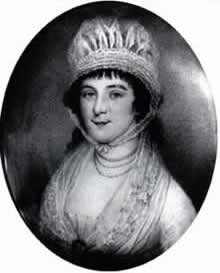
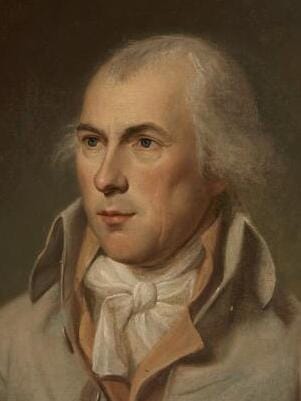
Toward the end of 1794, the earliest known portrait of Dolley was painted by James Peale. It’s a miniature, and today it’s in the Library of Congress. I’ll put it on the webpage for this episode, along with a portrait of James Madison from 1792. You can find the link in the show description.
After the wedding, the Madisons stayed at Harewood for a few days before setting out to visit some relatives. They had intended to visit Montpelier so Dolley could meet James’s parents, but she fell ill with what might have been a relapse of an earlier case of malaria, and they were forced back to Harewood so she could recuperate. By the time she recovered, they had to be on their way to Philadelphia so James could resume his service in Congress.
Richard Côté nicely summed up Dolley’s return to Philadelphia in his book, Strength and Honor: The Life of Dolley Madison:
“When Dolley Payne Todd Madison stepped from her carriage onto the streets of Philadelphia in the last days of October 1794, she was a different person from the one who had left the city only a few weeks earlier. Her arrival after her whirlwind wedding trip did not return her to the quiet, understated world of her Quaker past but rather to the exciting world of fashion, politics, government, and international intrigue.
Her previous ten years had been filled with change, discovery, anguish, and sorrow. Her future seemed to offer joy and hope. One thing was certain: her marriage to a respected planter, scholar, and statesman placed her squarely in the national limelight. She would quickly have to adapt to her new position in society, and the accompanying acclaim and attention.”
The first notable change to Dolley’s social life was being shunned by her former Quaker friends. Only two friends who were still in the Quaker faith remained Dolley’s friends after her marriage to James: Anthony Morris and Betsy Pemberton. And she had old Quaker friends who had also been disowned by the Quakers, like Eliza Collins Lee. But she had a flood of new social acquaintances via James, not just his enormous family connections, but all his government and political connections too. He had been around a long time, and he knew everyone.
Upon their arrival in Philadelphia, James, Dolley, Payne, and Anna lived in a house James was renting from James Monroe, who had recently left Philadelphia to serve as minister to France. Monroe also served as unofficial interior decorator for the Madisons while he was in France, buying and shipping home crates of furniture ordered by the newlyweds.
For the 1795 session of Congress, the Madisons moved into their own home on Spruce Street. I’m not quite sure what happened to the house at Fourth and Walnut Streets that John Todd had purchased, and Dolley had returned to after John’s death. One biographer makes a passing mention that Dolley was advised by an attorney to put the house into a trust for young Payne. So, presumably, the house was being rented out, and the income from the rental put into a trust account.
The Madisons enjoyed a robust social life, hosting and attending many dinners, teas, and parties throughout the city. They attended George Washington’s birthday ball in January 1795, but were probably there as admirers, rather than partaking of the dancing. Dolley never learned to dance, because it was forbidden by the Quakers, and there’s no mention in any of the books I read of James being a dancer.
All these social events provided ample opportunities for the ladies (and the gentlemen) to show off their fashion sense, and fashions were changing dramatically as the turn of the century approached. During the Revolutionary War years and the period just afterwards, dresses were a little bit like straight-jackets. Tight corsets with whalebone stays cinched everything in; collars were high; sleeves were long; skirts were voluminous. Every inch of a woman was covered up.
But led by the French, American fashion was becoming less straight-laced and more exotic. One of Anna Payne’s friends, Sally McKean, described the new fashions in a 1796 letter.
“The bonnets are all open on the top, through which the hair is passed, either up or down as you fancy, but latterly they wear it more up than down; it is quite out of fashion to frizz or curl the hair, as it is worn perfectly straight. Earrings, too, are very fashionable.
The waists are worn two inches longer than they used to be, and there is no such thing as long sleeves. They are worn half way above the elbow, either drawn or plaited in various ways, according to fancy; they do not wear ruffles at all, and as for elbows, Anna, ours would be alabaster, compared to some of the ladies who follow the fashion; black or a colored ribbon is pinned round the bare arm, between the elbow and the sleeve.
There have come some new-fashioned slippers for ladies, made of various colored kid or morocco, with small silver clasps sewed on; they are very handsome, and make the feet look remarkably small and neat. Everybody thinks the millinery last received the most tasty seen for a long time.”
What Sally left out of her detailed description was the low-cut necklines that were becoming all the rage. I will let our good friend from season 2, Abigail Adams, share her thoughts on the new look:
“The stile of dress…is really an outrage upon all decency. I will describe it as has appeared even at the drawing Room—A sattin petticoat certainly not more than three breadths gored at the top, nothing beneath but a chemise. Over this thin coat, a Muslin sometimes, sometimes a crepe made so strait before as perfectly to show the whole form. The arm naked almost to the shoulder and without stays or Bodice. A tight girdle around the waist, and the ‘rich Luxurience of nature’s Charms’ without a handkerchief fully displayed.
The face, à la mode de Paris, Red as a Brick hearth. … To do justice to the other Ladies, I cannot accuse them of such departures from female decorum, but they most of them wear their Clothes too scant upon the body and too full upon the Bosom for my fancy. Not content with the show which nature bestows, they borrow from art, and literally look like Nursing Mothers….They show more of the bosom than the decent Matron or the modest woman.”
Good old Abigail Adams. You can always count on the Puritans for some comedy. Her reference to the women dressing without a handkerchief relates to the practice of wearing a thin handkerchief over the cleavage created by the lower-cut necklines of the new dresses. This was an attempt by some to be fashionable without being vulgar. Displaying cleavage was frowned upon by many.
But Dolley took to this new fashion and sort of made it her trademark. I suppose it helps that Dolley had what would colloquially be called an “ample bosom.” Every single biographer made mention of her large breasts, but not in so many words. I believe Dolley’s motto would have been, “if you’ve got it, flaunt it.”
During these first few years of marriage, with James consolidating his status as one of the foremost political thinkers of the age, and Dolley consolidating her status as the queen of Philadelphia society, they both probably expected that Dolley would soon be pregnant. After all, Dolley had her first child with John Todd just over two years after their marriage, and their second child was born about seventeen months after the first. But despite her youth and obvious ability to bear children, Dolley and James never had children together.
One assumes that James had some unknown fertility issues. Unlike with George Washington, there were no rumored illegitimate children that would indicate he was physically able to father a child. James was a loving step-father to Payne Todd, and doted on his many nieces and nephews, so it’s logical to conclude that he would have liked to have children. But it was not to be.
In fact, if Dolley and James had had children, she may not have been able to play the prominent social and political role that she did, because she would have been busy taking care of babies. As it was, she had only the toddler Payne to look after, and as he got older and went off to school, Dolley had more time on her hands than she otherwise would have if she had had younger children at home.
I’ll turn to Richard Côté again for a description of Dolley’s first forays into James’s life of politics:
“[T]he women of the nation’s capital played out their traditional roles while creating others. …Because they were denied direct access to power and could not vote, obtain a college education, practice a profession, or hold public office, women had to exercise power in subtle ways, by nurturing relationships, pulling strings, and orchestrating affairs of state from behind the throne.
In addition to friendship and companionship, the fashionable women of Dolley’s new world provided her with something of extreme value in her new role: information. The same women who bantered about hemlines and bonnet styles also exchanged first-hand information about what was going on in the homes of the men in Congress and the courts of Europe. …In the arena some have dismissed as ‘women’s gossip,’ Dolley and her female contemporaries shared valuable information, formed personal alliances, and learned the intimate details of the lives of families who ran the world.
[When Dolley] saw how power could be influenced through nuanced relationship building, she chose to master that art for the benefit of her husband and the causes he served. Her ability to build bridges and create a neutral social space where hostile opponents could speak frankly and in privacy, along with the depth of her personal bravery, would be the benchmarks of her fame for the rest of history.”
But her role as bridge-builder and behind-the-scenes power player was mostly in her future. In the immediate term, she and James were retiring to the countryside, to Montpelier, and to the life of plantation owners. James had decided that he would not stand for re-election to the House of Representatives in the 1796 election. And when John Adams, whom he despised, won the presidential election later that year, his choice to leave Congress and Philadelphia was justified.
Others tried to get him to remain in government service. Incoming President Adams even wanted to appoint James as a commissioner to France, but James had no desire to leave the country. He had never been a fan of travel by water, so crossing the ocean was a non-starter. The Virginia legislature tried to appoint him as governor, but he declined this post as well. He wrote that his decision to retire was “sincere and inflexible.”
And so, in the spring of 1797, Dolley, James, 5-year-old Payne, 18-year-old Anna, and James’s 22-year-old sister Fanny, set out for Montpelier. Dolley was finally going to see James’s family home and meet her in-laws.
Next week, we’ll join the Madisons at Montpelier as they enjoy four years of quiet country life before James is dragged back into politics when Thomas Jefferson is elected president.
Thanks for listening to this episode. It was produced by me, and the music is by Matt Dull. Please leave a rating or review in Apple Podcasts or Spotify if you haven’t done so already. Thanks!