Here are links to some maps you may find helpful viewing:

United States Map from 1800
by u/Perc-AngIe in Damnthatsinteresting
[Transcript]
Hello, and welcome to America’s First Ladies. I’m your host, Risa Weaver-Enion.
Episode 4.7 The President’s Hostess
Last week we saw Dolley get her first taste of being the President’s hostess, and even saw her attempt to guide Jefferson into better adherence to long-established diplomatic protocols, to no avail.
Meanwhile, James was practically drowning in State Department work. At the time he assumed the role of Secretary of State, the entire State Department consisted of just eight clerks. As Ralph Ketcham describes the work in James Madison: A Biography, “Madison had to draw reports for Congress when requested, correspond with governors, territorial officials, judges, marshals, and attorneys, preserve public papers, print and distribute the laws, supervise the patent office and the census, and keep the Great Seal of the United States, used to authenticate documents. As foreign minister, the secretary had to correspond with American ministers and with dozens of consuls scattered around the world, deal with foreign embassies in Washington, issue passports and ships’ papers, and act as savior and/or truant officer for stranded American seamen.”
Soon after taking on the job, James wrote, “I find myself in the midst of arrears of papers, etc. etc., which little accord with my unsettled health.” Two months later he apologized to a friend for not writing, saying, “Having brought with me to the place a very feeble state of health, and finding the mass of business in the department, at all times considerable, swelled to an unusual size by sundry temporary causes, it became absolutely necessary to devote the whole of my time and pen to public duties, and consequently to suspend my private correspondences altogether, notwithstanding the arrears daily accumulating. To this resolution I have thus far adhered.”
At a time when writing letters still required a quill and ink pot, you can imagine how time-consuming it would be to write anything. It’s no wonder that his personal correspondence suffered.
I now need to cover two important things that happened during Jefferson’s first term that I wasn’t able to work in last season: the Louisiana Purchase and the Lewis and Clark expedition. It’s important to remember that, unlike today, America in the early 1800s still mostly consisted of a narrow strip of land hugging the Eastern seaboard along the Atlantic Ocean. Recent additions to the original 13 colonies were Kentucky in 1792 and Tennessee in 1796, both of which extended the U.S. territory further west, up to the Mississippi River. The rest of the continent of North America was divided between the French, Spanish, and British.
I’ll put some maps on the webpage for this episode so you can see this visually, because it might be hard to follow just by me describing it. You can find the link in the show notes.
Florida was actually divided into West Florida and East Florida, both controlled by Spain, and usually referred to as “the Floridas.” West Florida contained what is today the panhandle of Florida, and it extended all the way across to the city of New Orleans, which was controlled at different times by the French and the Spanish. North of that was the Mississippi Territory, then Tennessee, then Kentucky, and then the Northwest Territory. Although from our perspective, we think of the “northwest” as being Oregon and Washington state, in this time period, it was what would later become Ohio and Michigan.
The Louisiana Territory was a vast tract of land, stretching all the way from present-day Louisiana in the south, up through the Plains states, and into the far west. It encompassed part or all of what is today Montana, Wyoming, Colorado, the Dakotas, Nebraska, Kansas, Oklahoma, Minnesota, Iowa, Missouri, Arkansas, and Louisiana.
The states that we know today as California, Arizona, New Mexico, Nevada, Utah, and Texas were all controlled by Spain.
The Mississippi River was essentially the eastern border of the Louisiana Territory, and navigation rights on the Mississippi were of paramount importance to all the countries who claimed territory on the North American landmass. It was the easiest way to transport everything over a great distance, and it ended in New Orleans in the Gulf of Mexico, making it of strategic importance for trade and shipping. You also need to keep in mind that trade with the West Indies, what we know as the various Caribbean islands today, was super important in the 1800s.
The other piece of background information you need is that France and Britain were at war with each other on an on-and-off basis from 1792 all the way up until 1815. America gets caught in the middle of these wars repeatedly, and the French-British conflict eventually leads to the War of 1812 between America and Great Britain. We’ll get there, but not today. The Quasi-War with the French that took place during John Adams’s presidency, which we discussed in episodes 2.12 and 2.13, was also an off-shoot of the Franco-British conflict.
As I also mentioned in episode 2.13, General Napoleon Bonaparte had seized power in France at the end of 1799 and declared himself First Consul. He would eventually also declare himself Emperor, but we don’t need to worry about that right now. Napoleon’s designs on world domination are at the root of a lot of geopolitical conflict in the first two decades of the 19th century. And he’s the one who suddenly decided to sell the Louisiana Territory to the United States.
It all happened during a lull in the war between France and Britain. The Treaty of Amiens in March 1802 ended (but only temporarily, as it turned out) war between the two countries. France then turned its attention to the West Indies, specifically Saint Domingue, alternately known as Santo Domingo, and today known as the island that contains both Haiti and the Dominican Republic.
This rabbit hole is deep enough already, so I’m not going to go any further into the Caribbean situation, other than to say that Jefferson and Madison were worried that French interest in the Caribbean would eventually translate into French interest in North America to a greater extent. As I mentioned earlier, New Orleans changed hands between the Spanish and the French. It was founded as a French colony, then turned over to the Spanish after the French and Indian War, and then in a secret treaty in 1800, Spain conveyed it back to France, but France wanted Spain to maintain control until such time as France asked for it to be relinquished to them.
So the U.S. wasn’t really sure in 1802 who was in control of New Orleans and the Louisiana Territory. The U.S. preferred that it be in the hands of Spain, because it was considered to be a weaker country than France. Despite the secret treaty of 1800, Spain still held possession of New Orleans and the Louisiana Territory as of 1802. Plus Napoleon was trying to convince Spain to give him the Floridas.
Matters were brought to a head in November 1802, when the Spanish intendant in charge of New Orleans closed the port to American commerce, which was a violation of a treaty from 1795 between the U.S. and Spain. Jefferson and Madison decided to send James Monroe to France to assist the ambassador there, Robert Livingston, in negotiating with Napoleon. They were all but certain that Spain was soon going to hand over New Orleans to the French, so they were authorized to negotiate to purchase New Orleans, as well as the Floridas, if France had managed to pry them away from Spain. There was no intention to purchase all of the Louisiana Territory. The U.S. just wanted New Orleans so they could secure access to the port for purposes of shipping and trade.
But then things started going very badly for Napoleon and France. Practically their entire army invading Saint Domingue was killed by yellow fever. Then the reinforcement fleet that was supposed to sail for Saint Domingue was trapped in ice in the Dutch harbor. Then the King of Spain refused to cede the Floridas to France. And somehow in the midst of all of this, Napoleon started to get bored with peace. He wanted to re-start the war with Britain, and in the interest of not splitting his focus, that meant more or less abandoning his pretensions to control in the Americas.
And so, on April 11, 1803, French foreign minister Tallyrand summoned the U.S. representatives and asked them if they would like to buy Louisiana. All of it. New Orleans and the whole kit and caboodle. The U.S. ministers declined the offer, because they weren’t authorized to buy all of Louisiana, just New Orleans. Ambassador Livingston immediately wrote to Madison back in Washington, “The field open to us is infinitely larger than our instructions contemplate. …We shall do what we can to cheapen the purchase but my present sentiment is that we shall buy.”
Now, given what we know about the slow rate of travel across the Atlantic Ocean, there’s no way Livingston’s letter reached Madison with time for Madison to reply before the U.S. ministers accepted Tallyrand’s offer on April 29. But the French were pressing the U.S. for an answer, and the price of $15 million seemed like a bargain. So the U.S. ministers must have just assumed that Jefferson and Madison would be okay with them committing the U.S. to this vast acquisition of land. That’s quite a gamble! But it paid off, because when news of the purchase finally reached Madison in July, he wrote back that it was “a truly noble acquisition.” And Congress ratified the treaty that encompassed the purchase later that year.
The Louisiana Purchase instantly doubled the size of the U.S. The territory covered 828,000 square miles, or about 530,000,000 acres. Based on the purchase price of $15 million, the U.S. paid about $18 per square mile. It might be the steal of the century. And for context, $15 million in 1803 is worth about $450 million today.
Over the rest of 1803 the transfers took place. First, Spain had to effect the transfer to France, and then France transferred everything to the U.S. It was all completed by December 20, 1803. I should mention that throughout this entire process, and indeed, in the century before this transaction, no one bothered to consult with the thousands of Native Americans who had made their home on this land long before the colonizers showed up. Typical.
The Louisiana Purchase tied into the Lewis and Clark expedition. In February 1803, before the purchase of the Louisiana Territory was even contemplated, Congress approved funding for an expedition from St. Louis, up the Missouri River, to the Pacific Coast. The goal was to find the rumored “Northwest Passage,” which was supposed to be a water route connecting the Mississippi River to the Pacific Ocean via the Missouri River. Turns out, it doesn’t exist. There’s a minor obstacle known as the Rocky Mountains in the way. But they didn’t know that when they left.
By the time the expedition set out in May 1804, the transfer of the Louisiana Territory to the U.S. was complete, and Lewis and Clark’s team was also tasked with exploring this new territory and defining its boundaries. Their 2 ½ year journey greatly expanded knowledge of the American West, and established relationships with many of the tribes living on that land.
Dolley was a great supporter of Lewis and Clark’s expedition. Meriwether Lewis was a long-time friend of Thomas Jefferson (you may recall that Martha Jefferson Randolph named one of her 12 children Meriwether Lewis Randolph), so Dolley had met him many times at the President’s House. She was on-hand for their farewell dinner before setting out for St. Louis, which was the jumping off point for the expedition. And when the team returned in 1806, they gave Dolley some of their cooking utensils from the trip as a memento.
Throughout Jefferson’s first term, Dolley continued to serve as his hostess. She quickly became known for her fashion sense, her colorful gowns, and the feathers she wore in her hair. She was also fond a cheeky red beret that she wore tilted at just the right angle. The receptions held at the President’s House came to be known as Mrs. Madison’s levées. No word on how Jefferson, who had tried to rid American politics of that word, felt about this.
One observer wrote that Dolley would give guests a tour of the house: “Then through the house we sallied forth from one end to the other, Mrs. M seemed quite at home here, and in fact appeared to be mistress. She took us from room to room, in her usual sprightly and droll manner.”
Bruce Chadwick, in James & Dolley Madison: America’s First Power Couple, writes, “Dolley engineered her receptions so that many people got to meet her husband under the best of circumstances and came away with a good impression of him. She arranged seating plans so that he could shine in conversations during dinner, always talking to a different group of people each night. …She often positioned him at one place in a room at a reception or ball and then, in a subtle way that few recognized, casually brought people over to meet him and chat with him. He could glow as both the very public secretary of state and the private Mr. Madison[.] …People who had only read about Madison or only knew him slightly came away with a whole new, and better, opinion of him at these parties, thanks to his wife.”
Dolley also worked at these parties to ensure that Jefferson socialized with the most important people. She also reminded him that while wearing bedroom slippers was acceptable when he was at home during the day, proper dress was required for these formal social occasions. Dolley coordinated with Jefferson’s French chef to ensure that the menus for these dinners and parties showed off America’s bounty.
A guest at one dinner described the meal in his diary, writing, “dined at the President’s…rice, soup, round of beef, turkey, mutton, ham, loin of veal, cutlets of mutton or veal, fried eggs, fried beef. A pie called macaroni, which appeared to be a rich crust filled with strillions of onions or shallots…tasted very strong and not very agreeable. …ice cream very good, crust wholly dried, crumbled into thin flakes; a dish somewhat like a pudding—inside white as milk or curd, very porous and light, covered with cream-sauce—very fine. Many other jim cracks, a great variety of fruit, plenty of wines, and good.”
I tried to figure out what on earth a jim crack is, but I wasn’t very successful. It seems to have been a term for showy, useless trinkets, so I’m not quite sure what this guest meant by including it in a description of dinner. Maybe there was just a lot of other random stuff on the table. I don’t know he could have noticed, considering how many other foods were included. Nobody can ever say that the Virginians don’t know how to eat!
Dolley re-created their social scene from Washington whenever they were at Montpelier. You’ll recall that both Jefferson and Madison had a distaste for the Tidewater region of Virginia, preferring their clean mountain air. Washington was located in the low-lying tidewater region, and both of them insisted on leaving every year during the worst part of summer. Jefferson went to Monticello each April as well, but the Madisons couldn’t always get away to Montpelier twice a year, and often made the trip only for the months of August and September.
Dolley and James hosted parties, receptions, and overnight guests continuously during their weeks at Montpelier, and then returned to Washington and hosted dinners and parties at their own home, or with Jefferson at the President’s House.
In the early years of Jefferson’s presidency, not that many Congressmen brought their wives with them to Washington. Until Dolley showed up and started hosting dinners and parties left and right, there wasn’t much reason for a woman to want to be in Washington. Dolley expanded the social circle of Washington beyond simply the spouses of elected representatives to include the wives of government employees, diplomats, and local residents who didn’t have anything to do with government. She had maps of the residential neighborhoods drawn up, and created lists of who lived where so she could balance the guest list at various parties.
She and James rode through town in an easy-to-spot dark green coach with a silver monogram on the doors and windows. It had Venetian blinds installed, and even candles for nighttime journeys. They made social calls throughout Washington in their stylish carriage. Although, honestly, I don’t know how James had time for any of this, with his mountain of paperwork and correspondence to deal with at the State Department.
Dolley spent the majority of her time organizing Jefferson’s social events. By the end of his first year as President, she was hosting an event almost every night at the President’s House, and sometimes as many as three in a day. She was also on-hand for state dinners, official visits, and holidays, acting as hostess for the all-day open houses held on New Year’s Day and the Fourth of July. It must have been exhausting. And on top of that, she was still trying to raise her son, who was not quite 10.
Many people had lots of praise for Dolley. One presidential guest wrote, “there is something very fascinating about her—yet I do not think it possible to know what her real opinions are. She is all things to all men.” John Quincy Adams wrote that she was “the most beautiful lady in America…the liveliest, endowed with the greatest charm, and possibly the most sensible.” Margaret Bayard Smith wrote, “Mrs. Madison was a foe to dullness in every form, even when invested with the dignity which high ceremonial could bestow.” After hearing her dinner discussions on topics as varied as foreign trade problems and the latest fashions, Martin Van Buren said, “Mrs. Madison’s talk at dinner is free on any matter.”
There were also some back-handed compliments doled out to her, as when the British minister to America wrote, “She is a very handsome woman and tho’ an uncultivated mind and fond of gossiping, was so perfectly good tempered and good humored that she rendered her husband’s house as far as depended on her agreeable to all parties.”
In March 1804, Dolley lost her closest companion, her sister-daughter Anna, when Anna married Congressman Richard Cutts of Maine, which at that time was a district of Massachusetts. Anna was 25 and Richard was 34 and quite wealthy. Dolley missed Anna terribly, writing to her while she was still making the rounds with her new husband, “Tho few are the Days passed since you left me my dearest Anna they have been spent in anxious impatience to hear from you—your letter from Baltimore releaved [sic] my mind & the one from Philadelphia (this hour receaved [sic]) gives me the greatest pleasure—To trace you & your dear Husband in [that] City, where we have spent our early years to find that even there, you can recollect with affection the solitary being you left behind, reflects a ray of brightness on my somber prospect.”
But Dolley didn’t have long to be sad about Anna, because the whirlwind of gatherings and social events continued. Horse racing was a popular pursuit in early 19th century Washington, and the area was home to several racetracks. Dolley attended regularly to cheer on her favorite horses. She also was a fan of card games played for money, especially one called loo. I won’t try to explain it. Her other vice, surprisingly, was taking snuff. This practice became popular among women after the French Revolution. Aaron Burr’s daughter even commented on it in a letter to her father after attending a dinner with Dolley, writing, “she is still pretty; but oh, that unfortunate propensity for snuff-taking.”
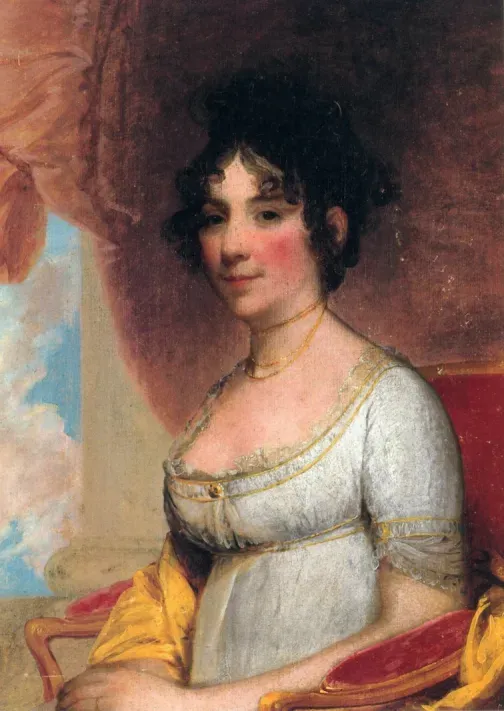
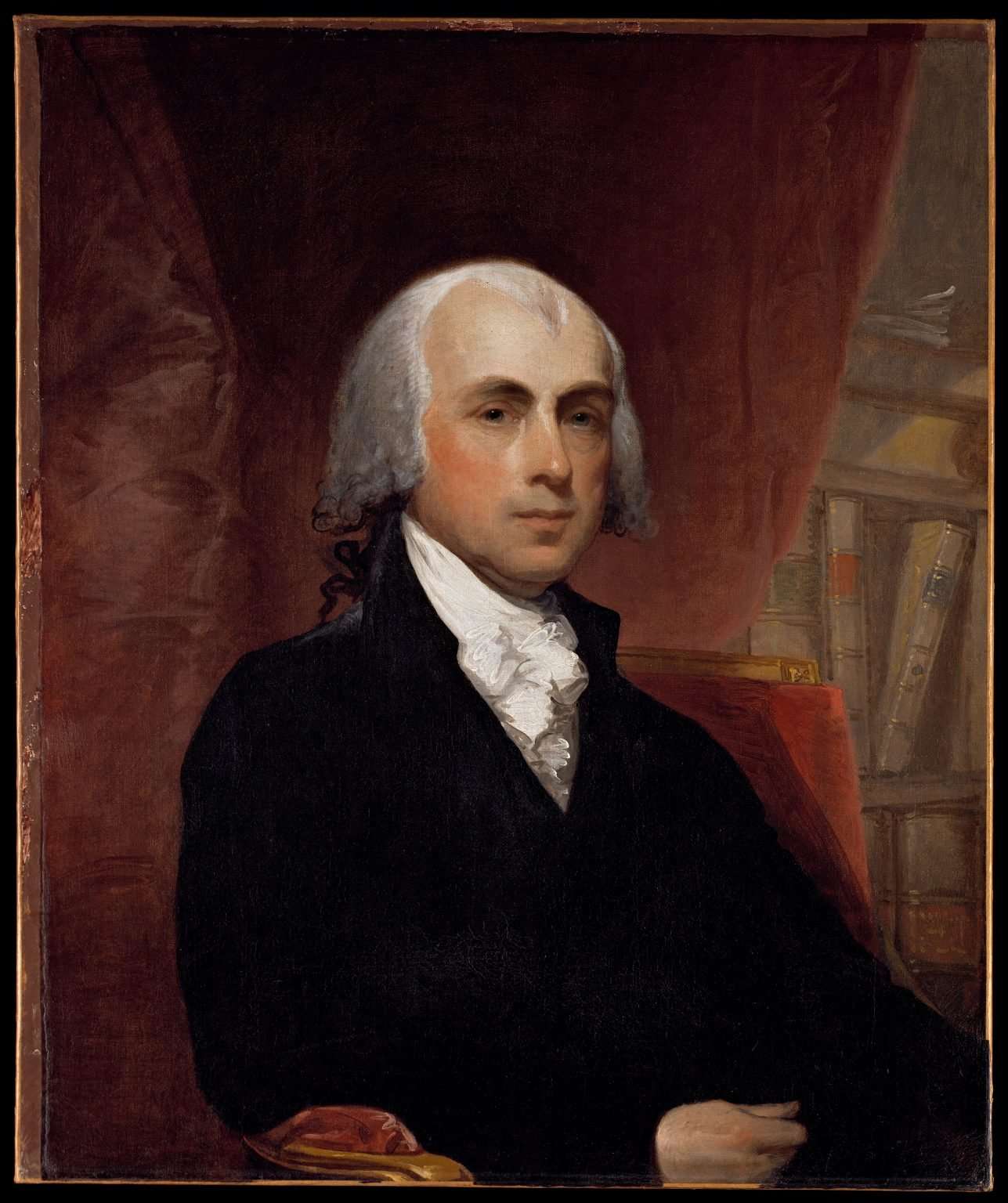
In 1804, Dolley and James sat for portraits by Gilbert Stuart, who was the nation’s preeminent portraitist. I’ll put the portraits on the webpage for this episode—find the link in the show notes. Dolley wore one of her trademark bosom-enhancing Empire-waist dresses, along with a bold red lip and heavily rouged cheeks, in the French style. I don’t think we have to try too hard to imagine what Abigail Adams thought of it.
1804 was also an election year. At their nominating caucus in February 1804, the Republicans replaced Aaron Burr on the ticket as the Vice Presidential candidate with Governor George Clinton of New York. Clinton was old and feeble, but replacing Aaron Burr turned out to be a smart move after he, you know, killed Alexander Hamilton in a duel in July.
You may recall that Dolley and Aaron Burr were friends—he had introduced her to James back in 1794, and she had made him the guardian of Payne in the will she executed during her brief widowhood. No doubt she was pained by Burr’s actions, but the only quote we have on the subject is from a letter to her sister where she wrote, “You have herd [sic] no doubt of the terrible duel & end of poor Hamilton.”
Burr was charged with murder in both New York and New Jersey, but he never stood trial. He even served out the remainder of his term as Vice President, until March 1805. But not without first engaging in some light treason.
In August 1804, the British ambassador Anthony Merry reported to London, “I have just received an offer from Mr. Burr, the actual Vice President of the United States…to lend his assistance to his Majesty’s Government in any Manner in which they may see fit to employ him, particularly in an endeavor to effect a separation of the Western part of the United States from that which lies between the Atlantick [sic] and the Mountains, in its whole Extent.” Burr would eventually be charged with treason in 1807, but he was acquitted because no witnesses came forward to testify as to his treason.
He wasn’t the only one committing treason in 1804. Disappointed by Republican successes, High Federalists Timothy Pickering of Massachusetts and Roger Griswold of Connecticut began speaking of detaching New England, and possibly New York and New Jersey from the Union. You’ll recall from earlier discussions that the High Federalists were the most extreme branch of the Federalist party, and typically the ones most in support of a strong federal government. There’s no small amount of irony in a High Federalist conspiring to secede from the Union. They even supported Republican Aaron Burr for New York governor in the April 1804 election, hoping that he would then bring New York to the secession campaign. But Burr lost that election, and then he killed Hamilton, so Pickering and Griswold’s plans went nowhere. But this isn’t the last we’ll hear of New England secession.
The Jefferson-Clinton ticket easily won the election of 1804, defeating the Federalist ticket of Charles Cotesworth Pinckney and Rufus King by an electoral college count of 162 to 14. Jefferson was riding high after the success of the Louisiana Purchase. And the Madisons would be with him for every step of his second term.
Jefferson’s second term was plagued by difficulties in foreign affairs, which were the start of a long road to the War of 1812. The U.S. was unsuccessfully negotiating with Spain for a purchase of the Floridas, Spain was refusing to relinquish posts in New Orleans, which now belonged to the U.S., and war had resumed between England and France.
Throughout the Anglo-French wars, American shipping had suffered. I might as well explain impressment now, because it’s going to come up again later. Despite claiming neutrality in the various conflicts between Britain and France, both sides routinely attacked American ships trying to conduct trade with Europe. Britain was especially problematic because its gunships would accost American merchant ships on the sea, board them, ostensibly in search of deserters from the Royal Navy, and then take those sailors with them. And while that might not be a huge problem if they were only taking deserters, the issue was that they were often taking American citizens as well. These Americans were then “impressed” into service aboard Royal Navy vessels. The U.S. and Britain had been arguing over this situation for years, and it won’t be going away anytime soon.
James was trying to deal with this newly resurfaced diplomatic crisis from Philadelphia, where Dolley had gone for medical treatment in the spring of 1805. She ended up being in Philadelphia from May until November, to be treated for an ulcerated tumor in her knee. In the interest of continuing to regale you with gross medical descriptions, an ulcerated tumor is when a cancer breaks through the skin, creating an open, crater-like wound. It usually appears as a moist, bleeding, or scabbed lesion, and symptoms include pain, leaking fluid, and a foul odor. The tissue is often dead, which is why it smells.
Dolley wrote to her sister Anna on June 4, “I now write you from my bed to which I have been confined for Ten days with a sad knee—it became a painful Tumour [sic], & 2 Doctors were call’d in, & their applications of caustick [sic] & so forth gives me hopes of getting well but heaven knows when as it promises to be Tedious.”
"Caustick" refers to caustic soda, which is sodium hydroxide. Today, it’s used for industrial drain cleaning. In the 19th century, it was used to burn off diseased tissue and cancer growths. Fun! And you thought leeches were bad.
Shockingly enough, the doctor’s treatment didn’t work, and by July, Dolley’s knee was worse. Her leg was in a wooden splint wrapped tightly with cloth, presumably with more caustic applied underneath the wrapping to eat away at the dead tissue.
James was by her side almost the entire time she was in Philadelphia. Dolley wrote, “Mr. Madison does a profusion of business here—he writes Volumes.” She also told Anna, “here is my beloved Husband sitting anxiously by me & who is my unremitting Nurse.”
Dolley wasn’t thrilled to be spending the feverish summer months in Philadelphia, even if she was in Gray’s Ferry, which is where she stayed during the 1793 epidemic. She wrote to Anna, “I enquire every day & they tell me there is not a single case. Mr. Madison goes out a great deal, & does not tell me he hears of it—he is very subject to bilious attack’s [sic] & I am often miserable with fears for his health, as I have been the cause of bringing him here at this dangerous season, he laughs at my anxieties & our acquaintances aid him in persuading me that we are both in safety.”
Thankfully, there was no major yellow fever outbreak that year.
James had to return to Washington in late October, and Dolley wasn’t able to leave Philadelphia until a month later. It was the longest they had been apart since their wedding day, and it would stand as their longest separation until James’s death. They wrote letters to each other in the interim, and this is when Dolley sent the letter I mentioned in episode 4.6, asking for an update on negotiations with Spain and England. James gratified her interest with a long letter describing the situation.
Next week, we’ll return to Washington with Dolley for the remainder of James’s second term as Secretary of State. And her young son Payne will embark on what will be a lifetime of troublesome behavior.
Thanks for listening to this episode. It was produced by me, and the music is by Matt Dull. Please leave a rating or review in Apple Podcasts or Spotify if you haven’t already. Thanks!