Transcript]
Hello, and welcome to America’s First Ladies. I’m your host, Risa Weaver-Enion.
Episode 5.1 The Early Lives of Elizabeth and James
Hello, and welcome back for season 5! I hope you enjoyed our little detour into European history during the break between season 4 and season 5. For those who are feeling a little fatigued after the length of season 4, fret not. Season 5 will not be quite as long.
For starters, there’s way less information out there about Elizabeth Monroe than there is about Dolley Madison. Additionally, I don’t have to do a deep dive into any of the wars James and Elizabeth Monroe lived through, because we’ve already covered them in detail in past seasons.
One of the reasons there’s so little information about Elizabeth Monroe is, you guessed it, because after she died, James burned every scrap of paper she had ever written on. Granted, he did it in a fit of grief, but still. So frustrating.
In fact, there’s not a single biography that focuses on Elizabeth Monroe. There are a couple of compilations covering all the First Ladies that include brief chapters on her, and there’s a pamphlet that is sold at the museum shop at the Monroes’ Virginia plantation called Highland, but that’s it. So I had to rely on biographies of James Monroe and glean what scanty information about Elizabeth was contained within.
The other reason there’s not a lot out there about Mrs. Monroe is that, unlike Mrs. Madison, she wasn’t outgoing, vivacious, or the life of any party. We’ll learn more about why that is, but she gets a bad rap having had to follow one of the liveliest and most well-known First Ladies.
Speaking of the term “First Lady,” we’re still not using it to describe the President’s wife. As I mentioned at the end of last season, it’s possible that President Tyler referred to Dolley Madison as the first lady of the land in his eulogy of her, but no written record exists. The term doesn’t appear in print until 1860, so we’ve still got a few women to get through before we officially start calling them First Lady.
So with that said, let’s dive into the life of Elizabeth Kortright Monroe. She was born on June 30, 1768 in New York City. Her father Lawrence had made his fortune in some combination of West Indies trade and privateering during the French and Indian War. If you recall, privateers were private ships authorized by the government to attack enemy ships at sea. Any goods seized from captured ships were sold off, and the profits distributed among the men serving on the privateered ship. The owner of the ship kept the bulk of the profits for himself. During the French and Indian War, Kortright would have been operating on behalf of the British to capture French ships.
Lawrence Kortright’s ancestors were Dutch and Flemish. His Flemish ancestors had emigrated from Flanders to Holland, and then his great-great grandfather emigrated from Holland to New Amsterdam in 1663. The following year, New Amsterdam was renamed New York after the Dutch surrendered it to the British. The colony was named after the Duke of York, who was the brother of the sitting English monarch, Charles II, and would eventually become James II. We learned about them in part III of our supplemental miniseries on Anglo-French relations.
Elizabeth’s mother was Hannah Aspinwall. I have zero information about where her family was from, when they came to America, and how she met Lawrence Kortright. One of my sources says she was the daughter of a sea captain, but that’s all.
Elizabeth was one of five children. Sources disagree as to the order and names of the Kortright children, but I found a historical listing of Kortright genealogy going back to before they emigrated to America, so I’m going to consider that to be accurate. The Kortright siblings were John, Sarah, Elizabeth, Hester, and Mary. There seems to have been a sixth child, name unknown, who died in September 1777 of some sort of fever. The child was supposedly around 13 months old according to the death notice from Trinity Church in New York City.
Elizabeth’s mother, Hannah, had died a few days before the unnamed child. She was 39, and the cause of death was listed as being related to childbed. So she had likely either just given birth to a seventh child, who also died, or she had suffered a miscarriage and died of a resulting infection. There’s some speculation here, obviously, because I don’t have the facts.
What we do know is that Elizabeth was 9 years old at the time of her mother’s death, so she grew up without a mother. Interestingly, her father never remarried.
Please note the year in which Elizabeth’s mother died: 1777. This was during the occupation of New York City by British troops during the Revolutionary War. Elizabeth’s father seems to have taken no part in the Revolution. It’s unclear whether that’s because he had Tory sympathies or because he had five motherless children and didn’t want to leave them orphans. It’s quite likely it was both. New York was full of Tory sympathizers.
The Kortright mansion in New York almost burned down in 1778, during a blaze that damaged or destroyed almost 50 homes in Lower Manhattan. The fire was blamed on British mismanagement of the firefighters, but there’s no word on how it started in the first place. Thankfully, Elizabeth and her family escaped harm from the fire.
We can infer that young Elizabeth was well educated. But whether she had a private tutor or went to private school or boarding school, we don’t know. Given the time period, it’s likely she was privately tutored. Most girls of the time were educated at home. Presumably her sisters were educated as well, because it makes little sense to educate one daughter and not the others.
James Monroe biographer Harlow Giles Unger writes in The Last Founding Father: James Monroe and a Nation’s Call to Greatness:
“In contrast to most American women of her day…Elizabeth’s education went far beyond the ‘decorative’ and ‘ornamental’ arts that taught women how to maintain the homes and ornament the lives of future husbands. The decorative arts included skills such as sewing and knitting, while training in the ornamental arts taught young ladies to sing and play instruments such as the piano or harp. Elizabeth’s education, however, matched that of some of the most learned men of her generation—so much so that the silly banter of her female contemporaries often left her aghast, with little to say—and, indeed, aloof to some. Fluent in French, conversant in the great works of literature and the latest oeuvres of the philosophes, she kept abreast of political developments in America, England, and western Europe.”
He cites no sources for this information though. Another Monroe biographer, Tim McGrath, writes in James Monroe: A Life, “Compared to many women of their time, Elizabeth and her sisters were well educated. Their father’s social standing gave the girls access to the best teachers in New York, and exposed them to art, theater, music, and philosophy. Elizabeth spoke French with ease, and according to those who knew her, had already developed a cool detachment—but whether this was putting on airs or a cover for shyness we do not know.” McGrath cites Unger as his source for this information, so you can see we’re stuck in a loop here. But let’s just stipulate that Elizabeth was well educated, and unusually so for a girl of her time period.
And that’s literally everything we know about Elizabeth Kortright’s childhood. Appalling, right? We know more about Patty Jefferson’s youth and upbringing, and she never even actually served as First Lady.
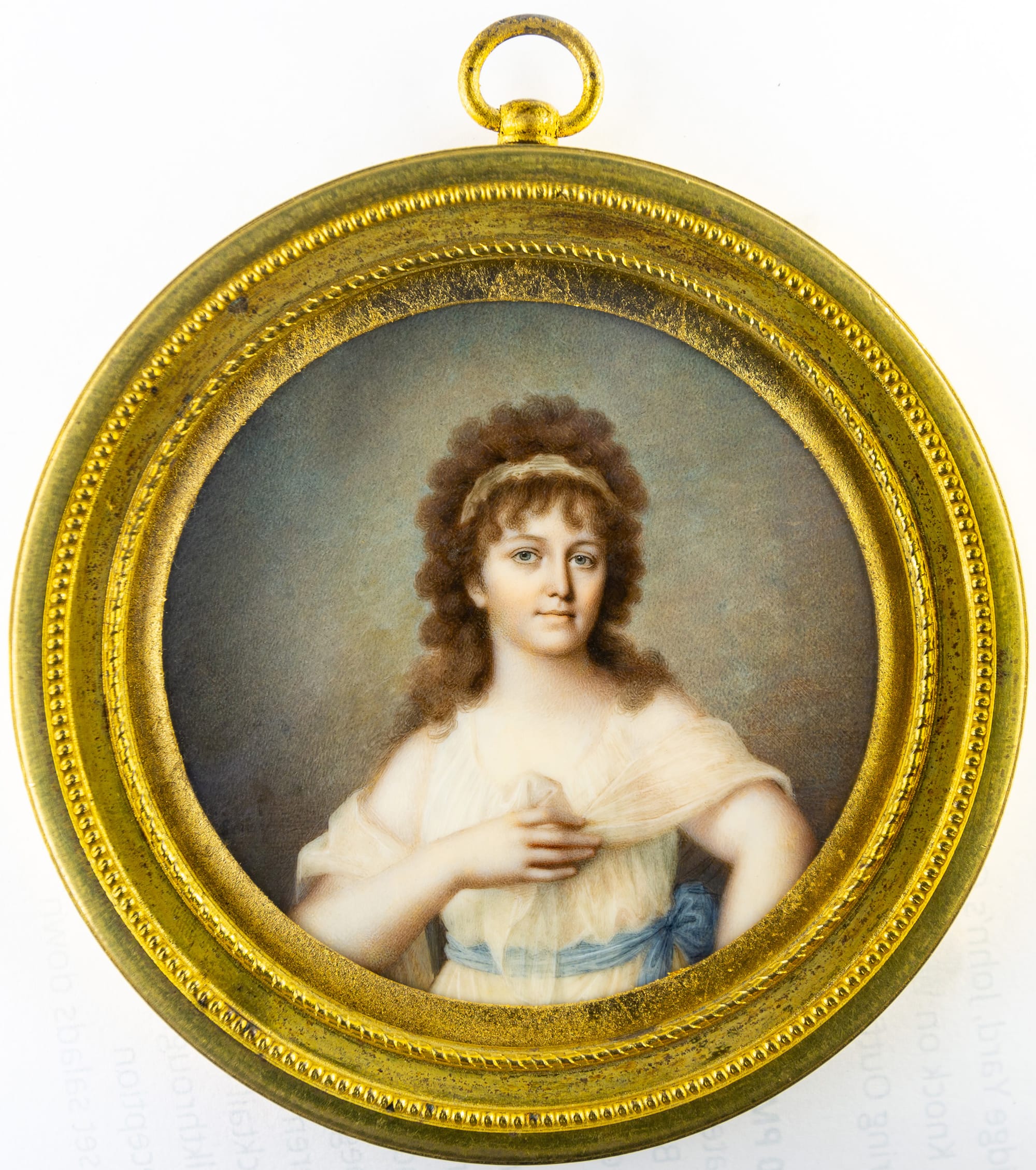
Elizabeth Kortright was also quite beautiful, if short. She was five feet tall, had long, brown, curly hair, blue eyes, and a rounded chin. A portrait of her from 1795, when she was 27, is in the Library of Congress. I’ll put it on the webpage for this episode—you can find the link in the show notes.
Sometime in 1785, Elizabeth Kortright met a young Virginian named James Monroe. Harlow Giles Unger writes that they met when James was serving as best man for his friend and fellow Congressman, Elbridge Gerry. But that can’t be accurate, because Elbridge Gerry married his wife in January 1786, and James and Elizabeth were married only a month later. So he obviously had to have met her sooner. James did, however, serve as Gerry’s best man, so that part is accurate.
In November 1785, James’s cousin William Grayson wrote a letter to James, telling him about an evening he had spent at the theater. He wrote that just as he took his seat, the Kortright sisters entered. “They made so lovely an appearance as to depopulate all the other boxes of all the genteel male people therein. … The young Ladies desire to be remembered to you.”
A few months later, on February 16, 1786, James Monroe and Elizabeth Kortright were married. He was 27, and she was 17.
So now, in keeping with my usual M.O., let’s go back and hear more about young James Monroe and his life up until he met the beautiful Elizabeth Kortright.
James was born on April 28, 1758. You know what that means? We can finally stop talking about the switch from the Gregorian to the Julian calendar, because all our characters were born after the switch in 1752. Hallelujah!
James Monroe’s ancestors were Scottish. After King Charles I was beheaded in 1649, James’s great-great grandfather, Andrew Monroe, who was loyal to the Crown, left for America, settling in Anglican Virginia in 1650, Westmoreland County, to be exact. Andrew’s descendent, Spence Monroe, was James Monroe’s father. He married Elizabeth Jones, the daughter of a well-to-do Welsh immigrant in neighboring King George County. Elizabeth was “particularly well educated for [a woman of] colonial days,” according to family members. Elizabeth and her brother, Joseph Jones, inherited considerable property from their father. Remember Joseph Jones, because he’s going to play a huge role in James Monroe’s life.
The Monroes had five children: Elizabeth, James, Spence, Andrew, and Joseph. They grew up in a typical Virginia farmhouse of the period. It was a one-story wooden house with a half-story dormered attic. There was a central hall with doors at each end so the breeze could cool off the house during the hot, humid Virginia summers. The hall also served as the living room, dining room, and kitchen. This was not a plantation with dozens of outbuildings.
When James was 11, his parents sent him to school in the only county school, which was well known enough that students came from all over Virginia to attend. This is where James met a young man who would be a lifelong friend, even as their politics diverged: John Marshall, future Chief Justice of the U.S. Supreme Court.
James’s mother died in 1772 after the birth of the youngest child, Joseph. Then the following year, James’s father died. As the eldest son, James inherited the 500-acre farm, as well as 300 acres that had been his mother’s share of her family’s farm. James had to drop out of school to try to run the farms, which were already underperforming thanks to years of monoculture; that is, growing only one crop year after year. And you know by now that the crop in question was tobacco.
Their uncle Joseph Jones essentially adopted the Monroe siblings. James’s older sister Elizabeth was around 20 at this point, so Uncle Jones provided the necessary funds Elizabeth needed to look after the three younger boys. He took James with him to Williamsburg, where he served as a member of the House of Burgesses, and enrolled him at the College of William and Mary.
While living in Williamsburg, Uncle Jones introduced young James to some very important people: Patrick Henry, Thomas Jefferson, and George Washington.
As tensions grew between Britain and the American colonies, James took part in an armed citizen attack on Royal Governor Lord Dunsmore, to prevent him from seizing the town’s munitions and gunpowder. This seems to have whet his appetite for rebellion, because in December 1775, at the age of 17, he quit college and joined the Virginia militia. He and John Marshall both served as lieutenants. Emulating General Washington, Monroe foolishly offered to serve without pay.
In August 1776, James’s militia regiment, The Third Virginia, began the long march to New York City, where General Washington and the Continental Army were trying to oust the British. They arrived just after the debacle that was the Battle of Long Island, and from a distance, they observed the debacle that was Kip’s Bay. But the Third Virginia acquitted themselves well in the Battle of Harlem Heights. It was the first time James had been in a real combat situation. Harlem Heights was not a major battle, and no ground was gained by the Americans, but no ground was lost either. In comparison to the Battles of Long Island and Kip’s Bay, it was a win.
But we all remember from season 1 how poorly the Continental Army fared in New York during the autumn of 1776. They retreated, and retreated, and retreated, until they were finally in New Jersey, and then Pennsylvania, just across the Delaware River from Trenton, New Jersey.
Young Monroe was assigned to count the various regiments as they walked by, to tally the remaining men. It was not promising. But James recorded this memory of seeing General Washington among his troops: “He was always near the enemy, and his countenance and manner made an impression on me which time can never efface. … A deportment so firm, so dignified, so exalted, but yet so modest and composed, I have never seen in any other person.”
By December 1776, The Third Virginia, which had started out with 600 men, was down to 181. As General Washington discussed a bold plan to sneak across the Delaware River on Christmas night and surprise the Hessians camped on the other side, the commander of the Third Virginia offered to lead the detachment that would approach Trenton from the northern road. James Monroe volunteered to join the detachment. It quite nearly cost him his life.
James and his detachment were among the first soldiers to be ferried across the river to the New Jersey side. Once they landed, they had over six miles of ground to cover to be in position while the rest of the army was slowly ferried across the river with their horses and artillery. As we all know from the famous painting, it was snowing hard as the army stealthily crossed the river. It snowed all night, until the temperature rose just enough to turn the snow to sleet.
After several hours of marching, the detachment reached the crossroads they were assigned to guard. They were under orders to deter any travelers who might pass by that way. They moved as quietly as possible, but they made enough noise to rouse a dog in a house they passed. Then the rest of the dogs in the house started barking up a storm, waking the owner. He came out to confront the soldiers, thinking they were thieves, but he was relieved to discover that they were Continentals. It turns out that he was a doctor, John Riker. After bringing the troops some food and warm drinks, he grabbed his gun and his bag and declared that he would go with them on their dangerous mission.
Once James and his detachment became aware that General Washington and the rest of the army were in place, it was time to begin the maneuver. It was a three-pronged strategy, approaching Trenton from different directions. The Third Virginia was part of the vanguard leading the way for General Washington and his troops. A Hessian sentry spotted them and opened fire, and then all hell broke loose.
Hessians, awoken by the gunfire, spilled out into the streets, quickly and impressively forming themselves into proper battle lines. General Henry Knox rained down artillery fire on them. Captain Alexander Hamilton did the same from his position. The Americans captured some Hessian cannons, and as the Hessians rallied to capture them back, the captain of Monroe’s detachment was struck and fell, but he was not mortally wounded. James immediately took charge, ordering two men to carry their injured captain off the street, and then leading the charge toward the Hessians.
James was shot in the chest by a Hessian musket, and he nearly immediately fell to the ground. The musket ball had severed an artery, and he was bleeding profusely. Some fellow Virginians carried him to Dr. Riker, who was still tagging along with the soldiers. His quick work saved James Monroe’s life. And really, when you think about it, Dr. Riker’s barking dogs saved James Monroe’s life.
Amazingly, there were no American fatalities at Trenton, and only four wounded, James and his captain among them. On the other side, 21 Hessians were killed, 90 wounded, and more than 900 taken prisoner when they surrendered after their Colonel was killed in the fighting.
After Dr. Riker stopped the bleeding, James was taken to the makeshift medical tent for further treatment. The musket ball was never removed, but the wound was cleaned with turpentine, of all things, and then cauterized. After the victory at Trenton, the Continental Army was ferried back across the Delaware to the Pennsylvania side, James on a stretcher. It took him about three months to recover from his injury, but he was promoted to captain as a reward for his bravery.
The problem with this promotion is that he was responsible for raising his own troops to command. He returned to Virginia to recruit, but was unsuccessful because the ardor for war had considerably died down and because he did not have the money to pay the expected recruiting bonuses. He asked his uncle, who was a Virginia delegate to the Continental Congress, for help, and Uncle Jones wrote to General Washington to see if there was a place for James on his staff. There wasn’t, but the general found a place for James. When he returned to join the army in the summer of 1777, he ended up as an aide to Brigadier General William Alexander, Lord Stirling.
James later wrote in his autobiography, “Young as I was, I became acquainted with all the general officers of the army, with their aides, and with all the other officers in that circle who were most distinguished for their talents and…came from all the states.” He also wrote that these friendships helped “break down my local prejudices and attach my mind and feeling to the union.”
Among those he met were Colonel Alexander Hamilton and the Marquis de Lafayette. He also came back into contact with his old friend John Marshall, who was deputy judge advocate of the army.
As an aide to Lord Stirling, James was with the army at the Battle of Brandywine Creek and at Germantown. When the army spent its miserable winter in Valley Forge, Lord Stirling returned home, but James stayed with the army, sharing a log hut with John Marshall.
James’s last combat of the war was the Battle of Monmouth Courthouse in June 1778. His reconnaissance work mid-battle was crucial to avoiding another bitter defeat. In December 1778, James resigned from the Continental Army and spent the winter in Philadelphia with his uncle. He wanted to command his own troops, and to that end, aimed to get an officer’s commission with the Virginia militia.
General Washington wrote him a glowing letter of recommendation, writing “it is with pleasure I take the occasion to express to you the high opinion I have of his worth. The zeal he discovered by entering the service at an early period, the character he supported in his regiment, and the manner in which he distinguished himself at Trenton, where he received a wound, induced me to appoint him to a captaincy in one of the additional regiments. … He has in every instance maintained the reputation of a brave active and sensible officer.”
The letter worked to the extent that the Virginia Assembly appointed James as a lieutenant colonel to lead one of the four regiments Virginia anticipated forming, but the Assembly failed to provide the required funds to pay recruits their recruiting bonuses. Without bonuses, recruiting was impossible.
He returned to his uncle’s house in Fredericksburg, where his uncle was serving as Virginia’s Chief Justice. Uncle Jones convinced James to leave behind the military and go back to William and Mary to study law, which he did. He also provided James with a letter of recommendation to Thomas Jefferson, who was governor of Virginia at the time.
Jefferson saw much to like in young James, who at this point was still only 21 years old. In his free time (the Virginia governor didn’t have a lot of actual responsibilities), Jefferson mentored a group of William and Mary law students. He added James to his group.
It’s unclear from the sources whether James was part of the Battle of Yorktown or not. It’s clear that he wanted to be, and when Lafayette arrived in Virginia with his troops, James went to meet with him to see if he could join them. But Lafayette was not in need of more officers, he only needed soldiers. Tim McGrath writes that Monroe therefore joined as a volunteer, but Harlow Giles Unger writes that Monroe was “all but despondent at not having participated in the historic Battle of Yorktown.” So maybe he was there, and maybe he wasn’t. But if he was there, he apparently did not contribute anything of note.
While serving under the tutelage of Jefferson, James decided to sell the land in Westmoreland County that he had inherited from his father. The farm still wasn’t producing well, and it would make no sense for James to live in Westmoreland County and practice law—the county already had plenty of lawyers. And his siblings weren’t living on that farm. His sister Elizabeth was by now married and living in Caroline County. His 16-year-old brother Andrew and 8-year-old brother Joseph lived with her. Their remaining sibling, Spence, had died young in 1775.
For the first time in a while, James had some money, thanks to the sale of the Westmoreland County farm. He had dreams of going to France to study there, but he was unable to make that happen. He was admitted to the Virginia bar in early 1782, and then was, as Tim McGrath puts it, “invited by his fellow citizens in King George County to represent them in the General Assembly.”
With much help and influence from his uncle, James won his election in April 1782, just before his 24th birthday. His friend John Marshall also won election to the Assembly, so they would serve together. They swore their oaths of office in Richmond on May 6. The two war heroes were then elected to the eight-member Executive Council, or Privy Council, which was the body that actually did the governing in Virginia.
But I use the term governing loosely, because it was still the wealthy Virginia planters who decided what did and did not happen in the state. As Harlow Giles Unger writes, “Although the Executive Council met daily, it was little more than a club. The planters who dominated it ruled their huge plantations like private fiefdoms. Having rebelled against the British government when it tried to tax them, they had no intention of granting Virginia’s state government the powers they had fought to deny the Parliament of England.”
After the peace treaty with the British was signed, governing did not get any easier. There was high inflation and unemployment, and almost zero collection of taxes. James wrote to a friend who was serving in the Confederation Congress, “The people are great against those measures which induce the necessity of taxes & there are many in the house who wish to court popular applause & who I fear will not stand to give up more important considerations to the attainment of this end.” In another letter he wrote to the same friend, “The Legislature have done nothing worthy of late.”
In June 1783, James was elected to the Confederation Congress himself, to replace the retiring Congressman James Madison. James was about to experience governmental impotence on a whole new level.
But first, he had some free time on his hands, because the Congress was not due to convene until December. So he spent the summer with Jefferson at Monticello. Jefferson, naturally, encouraged James to purchase land in Albemarle County, near Monticello, so he could build a home. James wrote that Jefferson assured him “that it would connect me with the western counties, from which he could throw into my hands much business. … Having formed a strong attachment to Mr. Jefferson…I resolved to purchase a tract of land…in the neighborhood.”
Jefferson had also been elected as a delegate to the Confederation Congress, so he and James set out together for Annapolis, where the Congress was scheduled to meet. James had spent much of the proceeds from the sale of his Westmoreland County land to buy land in the Kentucky territory, so he was once again nearly penniless upon his arrival in Annapolis. And he had still not been paid for his service in the Virginia Assembly. So Jefferson insisted that he share his quarters, and took young James with him to many parties, teas, and the theater.
James and Jefferson spent a lot of time together, and Jefferson was about 15 years older than James, so James very much looked up to Jefferson. To the point that it’s difficult in later years to tell whether James had any original beliefs of his own, or he just adopted Jefferson’s beliefs. He definitely relied on Jefferson quite a bit—too much, in my opinion—for guidance and advice on all aspects of life.
James was present for George Washington’s farewell address to Congress, after he resigned his commission. And he attended two formal dinners held to celebrate the General. James later wrote in his autobiography,
“The manner in which he took his leave…was such as evinced the high sense…of his merit. It could not fail to excite my sensibility to reflect that I had served as a lieutenant under him only a few years before.” He also wrote that “the theater on which I was now placed was a very important one. It was important not only to…fellow citizens, but to the whole civilized world, because the people were called on to make a fair experiment of the practicability of free government and under circumstances more favorable to their success than were ever enjoyed by any other people.”
James got to see first-hand the inability of the Confederation Congress to do anything at all. As we’ve discussed before, the Articles of Confederation were intended to hamstring the Congress more than to empower it. He complained to Jefferson about Congress, writing, “I never saw more indecent conduct in any Assembly before. The majority of the U.S. in Congress assembled are competent only to the inferior duties of government.”
The main thing James’s time in Congress did was to build his close relationship to Jefferson. Because of their age difference, it was more a mentor-mentee relationship than a friendship of equals, but Jefferson was a major influence on James, and when Jefferson was named to the commission in France negotiating a treaty of commerce, James lost his guiding light. James wrote to Jefferson, “I very sensibly feel your absence not only in the solitary situation in which you have left me but upon many other accounts. I shall write you constantly.”
Before leaving for France, Jefferson connected James Monroe and James Madison, knowing that Monroe would need a new guide and mentor. Jefferson wrote to Madison, “[Monroe] will be on the committee of the states. He wishes a correspondence with you; and I suppose his situation will render him a useful one to you. The scrupulousness of his honor will make you safe in the most confidential communications. A better man cannot be.”
But James made many connections and built relationships while serving in Congress. As Harlow Giles Unger writes, “Despite his quiet demeanor, Monroe had a rare gift for transcending regional differences in demeanor, speech, and social customs and making friends—many of them intimate—with congressmen from every part of the country. He was curious, courteous, open—never arrogant or condescending—and generous to a fault. Abigail Adams later noted his ‘agreeable affability,’ ‘unassuming manners,’ and ‘polite attentions to all orders and ranks.’”
James spent the summer recess in 1784 visiting northern New York state and Montreal. Congress reconvened in October 1784 in Trenton, New Jersey, but for weeks there weren’t even enough members to constitute a quorum. And once they did achieve a quorum, they still didn’t accomplish anything. James made plenty of proposals—demanding that British troops withdraw from all U.S. territories, as they were required to do under the terms of the peace treaty; demanding that Congress do something to guarantee Americans’ free access to the Mississippi River; proposing punitive tariffs on Canadian imports until the British complied with the peace treaty (remember, Canada was still British at this point).
He even demanded that the Articles of Confederation be strengthened and that Congress be given more power to sign commercial treaties on behalf of all the states. The Congressmen listened to James, and did nothing.
James spent the summer 1785 recess surveying the lands he owned in what would become Kentucky. When James returned to Congress in the fall, now meeting in New York City, he proposed incorporating the western lands into the Union sooner rather than later.
And while in New York, James was busy on another front, courting young Elizabeth Kortright.
Next week, we’ll pick up with Elizabeth and James’s marriage and life together as a young married couple.
Thanks for listening to this episode. It was produced by me, and the music is by Matt Dull.