[Transcript]
Hello, and welcome to America’s First Ladies. I’m your host, Risa Weaver-Enion.
Episode 5.11 The Final Years
Last week we ended in the autumn of 1824. The election was looming, Elizabeth was ill, and James couldn’t wait to get out of the Presidency.
I’m not going to spend too much time on the election of 1824, because we’ll cover it next season when we talk about Louisa and John Quincy Adams. But it was a little chaotic, with five candidates, all running as Republicans. There was no opposition party at the moment, and there wasn’t even really a cohesive national Republican party, so the state legislatures did the nominating, and naturally, they nominated their favorite sons. Tennessee nominated Andrew Jackson, Kentucky nominated Henry Clay, Massachusetts nominated John Quincy Adams, and some rogue Congressional Republicans nominated William Crawford, who was technically still serving as Treasury Secretary, but who had had a debilitating stroke in 1823, rendering him less than capable of serving in any public capacity.
If you’ve been counting, you’ll note that this is only four candidates. The fifth was Secretary of War John Calhoun, who had essentially self-nominated. But he soon dropped out of the running for the presidency and became the vice presidential candidate on both the Adams and the Jackson tickets. (Also, to be fair and technical about it, there were four other candidates who had initially declared for the presidency but dropped out early. By the time the election actually arrived, there were four possible viable candidates.)
The country was highly divided over just about everything, and mostly on geographic lines. The editor of the Georgia Patriot newspaper wrote that he was worried the divisiveness “will bury our free governments in irretrievable ruin.” Another newspaper wrote that a candidate “who shall unite the confidence, respect, and esteem” of the nation did not exist.
In comments reminiscent of Dolley Madison helping James to win the presidency in 1808, the candidates’ wives affected the popularity of the candidates themselves. A young lady from Germany was present at a drawing room reception at the President’s House and noted in her journal that John Quincy Adams and Andrew Jackson had commandeered separate rooms.
“If [Jackson] had not a very ordinary wife who smokes with him, he could certainly be nominated this time, but the ladies do not like to bow down to his wife. … They would however far prefer to elect Mr. Clay another candidate, and a great ladies man. Jackson has a charming, open hearted character, and great elegance of speech, says something agreeable to everyone. Adams is silent and cold and has a disagreeable face but his wife is much beloved.”
James avoided endorsing anyone for the presidency, much like his predecessors had done. But like his predecessors, he seemed to have a preferred candidate, and that was Adams. Adams was Secretary of State, and both James Monroe and James Madison had ascended from that position to the presidency.
The other big event of 1824 was the Marquis de Lafayette’s final visit to America. He arrived into New York, greeted by thousands of cheering Americans. He then spent several weeks touring America, being cheered at every stop. Every Revolutionary War veteran who was still alive and able to get to one of Lafayette’s stops came out to see him. He arrived in Washington on October 13 and was once again greeted by overwhelming crowds. He was feted at various dinners, including one at the President’s House. He then traveled to Virginia to see his old friends Jefferson and Madison, and the graves of George and Martha Washington at Mount Vernon. Monroe wrote to Madison that Lafayette was “in good health & spirits, and less altered in his form, than I expected, and not at all in his mind.”
It’s hard for the modern listener to comprehend just how revered Lafayette was in America. Outside of George Washington, he personified the American Revolution in a way that no one else did. In his book The Last Founding Father: James Monroe and a Nation’s Call to Greatness, Harlow Giles Unger describes the fervor that greeted Lafayette everywhere he went:
“His presence not only revived American patriotism, his words reminded Americans of their good fortune as the only people on earth with the freedom to govern themselves and their nation. … Wherever Lafayette traveled, cannons fired thunderous salutes, church bells pealed, bands blared, and crowds cheered hysterically. Cities competed with each other to stage the most lavish celebrations. New Yorkers deluged him with millions of flower petals….Boston built a gigantic arch of triumph over his parade route, and Philadelphia topped Boston by building thirteen arches—one for each of the original states. And everywhere—in every town, along every country road—tens of thousands of Americans waited hours in the sun or driving rain—sometimes through the night—to see him, touch him. Weeping veterans hobbled up to kiss his hand; mothers brought their babies for him to bless; fathers led their sons into the past, into American history to touch the hand of a Founding Father. To all he had the same message: that the proudest moments of his life had been to serve the United States as a young soldier.”
By the time Lafayette returned to America, his wife Adrienne had died. But he never forgot the risk Elizabeth had taken by visiting Adrienne in prison and eventually securing her freedom and escape from France. When he was reunited with Elizabeth on his second day in Washington, he cried and thanked her profusely. Lafayette’s secretary, Auguste Lavasseur, commented in his diary, “Although Mrs. Monroe has passed the age of 50, she remains a remarkably beautiful woman. Her friendliness leaves little opportunity to notice the slight toll that time has taken on her face.”
James could not spend as much time with Lafayette as he would have liked because he was busy writing his final annual address to Congress. He read it to his Cabinet on November 30, and John Quincy Adams remarked that, “It contains more matter of a general character than any of the preceding, and a Summary review of the policy of the Administration throughout its career.” The address was delivered to Congress on December 7. He concluded it with the following:
“Having commenced my service in early youth, and continued it since with short intervals, I have witnessed the great difficulties to which our Union has been exposed, and admired the virtue and intelligence with which they have been surmounted. From the present prosperous and happy state I derive a gratification which I cannot express. That these blessings may be preserved and perpetuated will be the object of my fervent and unceasing prayers to the Supreme Ruler of the Universe.”
By the time James’s final address was delivered to Congress, they knew they were going to have a role to play in deciding the election of 1824. Although the electoral college vote wouldn’t be certified until after the New Year, the unofficial results were known. Jackson had won the most electoral college votes, with 99. Adams came in second with 84, Crawford had 41, and Clay had 37. So you might think that Andrew Jackson won the election. Nope.
The problem was that Article II Section 1 of the Constitution and the 12th Amendment require a majority of the whole number of electors in order to win the presidency outright. There was a total of 261 electors, so no one had a majority, which would have been 131 electors. So the election would be decided by the House of Representatives, and only the top three vote getters would be in the running. But at least the Vice Presidency was settled, with John Calhoun having overwhelmingly won that position.
On New Year’s Day 1825, Elizabeth and James hosted their final Open House at the President’s House. Due to Elizabeth’s worsening illnesses, presidential social events had nearly ground to a halt in the previous months. Eliza stood in as hostess when she could, but she also was ailing, and she preferred to attend to her mother’s bedside rather than play hostess to a bunch of people she didn’t like. Without a woman to serve as hostess, women could not be invited as guests to presidential functions.
Without women at the events, the entire character of the events changed. One guest noted, “Everyone looked as if the next moment would be his last.” And James Fenimore Cooper lamented that “everyone left the house before nine.” Virginia Congressman William Rives left this account, written to his wife,
“The President’s dinner-party was as dull a scene as you can imagine. It consisted of about thirty members of Congress, drawn from every portion of the country, scarcely any two of whom were acquainted with each other, and, of course, there was little conversation. The party assembled about 5 o’clock, and sat down to dinner by candle-light…to hide the nakedness of the Presidential board. I scarcely ever saw a more scanty or meagre dinner. There were some ten or fifteen dishes only, scattered over an immense surface, at awful and chilling distances from each other.”
Leave it to a Virginian to call a dinner of fifteen courses scanty and meagre.
The New Year’s Day Open House was one of Elizabeth Monroe’s last public appearances. One guest left a detailed report that was published in the Philadelphia Times:
“Mr. Monroe was standing near the door, and as we were introduced we had the honor of shaking hands with him and passing the usual congratulations of the season. He is tall and well formed. His dress plain and in the old style, small clothes, silk hose, knee-buckles, and pumps fastened with buckles. His manner was quiet and dignified. … We were passed on and were presented to Mrs. Monroe and her two daughters, Mrs. Judge Hay and Mrs. Gouverneur, who stood by their mother and assisted her in receiving. Mrs. Monroe’s manner is very gracious and she is a regal-looking lady. Her dress was superb black velvet; neck and arms bare and beautifully formed; her hair in puffs and dressed high on the head and ornamented with white ostrich plumes; around her neck an elegant pearl necklace. Though no longer young, she is still a very handsome woman. … Mrs. Judge Hay…is very handsome also—tall and graceful, and, I hear, very accomplished. … Her dress was crimson velvet, gold cord and tassel round the waist, white plumes in the hair, handsome jewelry, bare neck and arms. The other daughter, Mrs. Gouverneur, is also very handsome—dress, rich white satin, trimmed with a great deal of blonde lace, embroidered with silver thread, bare neck and arms, pearl jewelry and white plumes in the hair. By the bye, plumes in the hair seem to be the most fashionable style of head-dress for married ladies.”
On February 9, 1825, the House of Representatives gathered to vote for president. As you may recall, when the House decides an election, each state gets one vote. Prior to the gathering of Congress, Henry Clay and John Quincy Adams had made an arrangement. Because Clay was not one of the top three vote-getters in the electoral college, he was not eligible to be voted in as president by the House. Clay offered to support Adams in the House vote, and bring the states that had supported him in the general election, Ohio and Kentucky. Shortly before the official vote, representatives for both Ohio and Kentucky announced they would be supporting Adams.
This was the second time the House of Representatives had to decide the presidency. The first time was in 1801 between Thomas Jefferson and Aaron Burr. You may recall that it took the House weeks to come to a decision, after voting over and over and over. This time around, it took just one day and one vote to decide the winner: John Quincy Adams. Adams ended up with 13 votes, Andrew Jackson with 7, and Crawford with 4.
Although both would later deny that there was any quid pro quo to Clay’s support of Adams, Adams did name Clay as Secretary of State, which had a history of being a springboard to the presidency. Whether or not this was part of the deal is still an open question.
The evening of February 9, the Monroes hosted their last presidential levée. Adams noted that the house was “crowded to overflowing,” and another attendee said everyone was “conversing cheerfully, like men who had just got rid of an irksome and onerous toil.” James was “encircled by a knot of politicians,” while Elizabeth was “attended by a circle of women, of rather brilliant appearance.” But they were not the stars of the show, nor was the Marquis de Lafayette, who was still in town. With Adams, Jackson, and Clay all in attendance, everyone wanted to know how they would behave around each other. Jackson had every reason to be angry. He had won both the popular vote and the electoral college, but had still lost the presidency. He would have the last laugh four years later though.
Clay departed before Jackson arrived, but Adams and Jackson did interact with each other—very civilly and politely. As Tim McGrath writes in James Monroe: A Life, “[The Monroes] and their guests had just witnessed the last civil remarks exchanged between the two men.”
On March 4, James and Elizabeth rode to the Capitol for the inauguration, picking up president-elect Adams and his wife, Louisa, along the way. After the inauguration, the Adamses hosted a reception at their home, and there was an inaugural ball that night at Carusi’s Hall. The Monroes made a brief appearance but departed early. On March 23, James and Elizabeth left the President’s House for the last time. They left behind most of their fancy French furniture, as part of the arrangement with Congress that it would be available for the use of subsequent presidents.
Their destination was Oak Hill, which was only a short 35-mile trip from Washington. Oak Hill had grown into a 2200-acre plantation by this point. It contained cattle, horses, over a thousand sheep, timber land, a grist mill, a distillery, and over 1000 acres of wheat, corn, rye, and oats. There were also orchards and a kitchen garden, along with 32 slaves to run and maintain the plantation. The original cottage had been replaced by a two-story brick mansion
The Monroes still owned Highland in Albemarle County, despite putting it up for sale back in 1823, and they were deeply in debt. Much of the indebtedness was due to the fact that Congress had refused for decades to reimburse James for expenses incurred during his diplomatic service in Europe. Harlow Giles Unger writes that James was $75,000 in debt, of which $53,000 of it was owed to him by Congress. And Tim McGrath further explains that of the $53,000 Congress owed him, $30,000 of it was interest. James put together an extensive dossier outlining all of his expenses, and included letters and evidence from both Jefferson and Madison, who had been President and Secretary of State when James was sent to Europe.
In the summer of 1825, Elizabeth took advantage of some rare good health to make a trip to New York to see Maria, who was supposedly pregnant again. (More on that in a minute.) While Elizabeth was away, Lafayette made one last visit to see James before returning to France. President Adams came with him. After Adams returned to Washington, Lafayette and Monroe made a pilgrimage to Monticello to see the aging and ailing Jefferson.
Toward the end of 1825, James received an offer for a portion of Highland that he was forced to accept because he needed the money so desperately. He sold the most fertile 900 acres for $18,000, which was immediately claimed by the Bank of the United States against the debt he owed. In 1826, when the bank threatened to sue him for the rest of the outstanding debt, he was forced to turn over the estate to them. So, in a word, Highland was in foreclosure.
Congress did him no favors when it came to reimbursing him for his expenses. The Senate Committee of Claims cut the $53,000 claim down to $29,513, and then the House cut it further to $15,900—a sum that was 30 cents on the dollar of what Congress owed him.
In June 1826, Maria gave birth to her fourth child overall, third surviving child, and second son. I realize that a summer 1826 birth does not comport with my earlier statement that Maria was pregnant in the summer of 1825 when Elizabeth went to visit her. I can’t reconcile that discrepancy because there just isn’t enough information about Maria and the births of her children. Wikipedia actually gets the birth year wrong for two of them, by completely misreading Tim McGrath’s book, which I’ve relied on extensively.
At any rate, the letter from Sam Gouverneur to James announcing the birth of Samuel L. Gouverneur, Jr. is dated June 15, 1826, so we can be reasonably certain that the baby was born shortly before that. Whether Maria possibly could have been pregnant the previous summer depends on your definition of summer, because she couldn’t have been pregnant any earlier than September. Regardless, the Monroes had a new grandchild, and his name was Sam.
July 4, 1826, was the country’s “Jubilee,” it’s 50th anniversary. The four living ex-presidents, John Adams, Jefferson, Madison, and Monroe were all invited to the celebrations in Washington, but they all declined due to health and age. And as we know, in the end, both Adams and Jefferson died on July 4, 1826, so their excuse was legit.
After Jefferson’s death, James wrote to Jefferson’s daughter, Martha Jefferson Randolph, “The late calamity with which you have been afflicted by the loss of your estimable father, my friend, has given me the most heartfelt concern. … If in any mode, I can render you any service, or contribute to the welfare of your family, I beg you to command me. … If my presence at Monticello should be deemed useful…I shall most cheerfully attend.”
There was more bad news to come in 1826. While James was away with Madison in Charlottesville, attending to business of the University of Virginia, Elizabeth had a bad fall and actually fell into the fireplace, resulting in burns on her arms and face. It seems this wasn’t the first time she had had an episode where she lost control of her body. When the doctor was summoned to treat her burns, he also diagnosed her with epilepsy. Eliza was there with her mother, but Elizabeth demanded that Eliza not tell James about the incidents. There’s no evidence that Elizabeth had suffered from epilepsy in childhood, but adult-onset epilepsy is fairly common, more so after the age of 65. Elizabeth was only 58 at this point, but there’s no reason to think that the doctor’s diagnosis was incorrect.
Throughout 1827, various factions attempted to drag James back into politics. First, the Virginia Republicans invited him to become a candidate for governor, which he declined. Then as the 1828 election approached, Congressman John Taliaferro asked James to consider being John Quincy Adams’s running mate. The current vice president, John Calhoun, had decided to join Andrew Jackson’s ticket. There was no way in hell James was going to run for vice president.
The last attempt to get him back into the political fray was made by the Virginia Assembly, which named him, and James Madison, as electors for the state of Virginia. He was quite explicit in rejecting the post, writing to the Assembly,
“I consider it a duty to decline the trust in question. … After the long and laborious service in which I have been engaged…it is my earnest desire to cherish the tranquility of my retirement. … In the pending elections, I have motives of a personal nature, which would make it particularly painful for me to interfere. Having held, in the office from which I lately retired, a very friendly relation with both candidates…it would be very repugnant to my feelings to take the part of either, against the other. … As a permanent rule I…conclude, that it would be better for our country…that those who have held the office of Chief Magistrate, should abstain, after their retirement, from becoming partisans in subsequent elections.”
Madison likewise declined the assignment, preferring to also remain neutral.
The election of 1828, which we’ll talk more about in the next two seasons, saw the renewal of the two-party system. The Republican party, which you may recall had originally been known as the Democratic-Republican party when it was first founded by Jefferson and Madison, had split into two official parties. President Adams ran as the candidate of the National Republican Party, with Richard Rush as his running mate. Andrew Jackson ran as the candidate of the Democratic Party, with John Calhoun as his running mate. The Democratic Party was now the party of the South, and of slave-holders. The National Republican Party would soon be recast as the Whig Party, and would claim the North. There will be a lot more to say about this in the future.
In the end, Jackson and Calhoun won the election of 1828. Jackson had 57% of the popular vote, as well as 178 of the 241 electoral college votes, an outright majority this time. There would be no repeat of the 1824 election decided by the House of Representatives.
Late in 1828, James suffered a bad fall from his horse, which nearly crippled him for the entire winter. Then in the spring of 1829, he fell again and injured his wrist, preventing him from being able to write. Elizabeth had to act the part of scribe, taking dictation and drafting all of his letters.
In happier news though, their granddaughter Hortensia, Eliza’s only child, was married at some point in 1829. She married a man named Nicholas Lloyd Rogers from Baltimore. He was a widower twice her age. There’s no mention of how they met. She was around 20 when she married, and her new husband was either 40 or 41. They would live in Baltimore and eventually have three children.
Toward the end of 1829, James was invited by the Virginia Assembly to attend the state constitutional convention being held that winter in Richmond. He almost couldn’t attend due to his health, but he pulled himself together at the last minute. Elizabeth was too ill to attend, so Eliza accompanied her father to the capital. You may recall from last season that James Madison was also a delegate to the convention, and he and Dolley spent that winter in Richmond, much to her delight. John Marshall was also a delegate, and those three lions of Virginia politics were joined by a few other leading names from the past. As Tim McGrath writes, “Young delegates and spectators knew they were watching a twilight of the gods.”
Monroe urged Madison to chair the convention as president, but then Madison nominated Monroe for the post, which he accepted. Madison chaired the legislative committee, and Marshall chaired the judicial committee. There couldn’t have been a more appropriate trifecta of leadership for the convention. But as we know from last season, the convention rejected all attempts at compromise or anything even approaching limitations on slavery. So the trifecta of political gods accomplished little. Monroe eventually had to resign as convention president and leave early when his health failed him.
The year 1830 was full of sickness and tragedy for the Monroe family. After returning from the Richmond convention, James’s health continued to fail him. Madison grew concerned after receiving no replies to his several letters to Monroe. In June, Monroe finally wrote that he had hoped that his health would have recovered enough for him to join Madison at the University of Virginia Board of Visitors meeting but, “In this I have been disappointed. I take exercise on horseback, in the morning, daily, and think that I gradually recover strength, but it is in very limited degree. Through the heat of the day I am forced to repose on a bed, incapable of any effort, without exposing myself to injury.”
Later in August, Monroe wrote to Madison that Elizabeth was in a weak state, preventing him from traveling. “I would not leave her alone.” To make matters worse, Eliza’s husband George Hay was also in a bad way. He had been thrown from his horse earlier in the year, injuring him so badly that he was unable to attend to his official duties. He also was suffering from “a violent rheumatism.” He traveled first to Washington for treatment, and then to White Sulphur Springs. While riding back from the springs in September, he fell violently ill. Eliza was summoned but by the time she arrived, her husband had died.
Two days later, Elizabeth’s health deteriorated so quickly that the doctors who were summoned could do nothing to help her. She died on September 23, 1830, at the age of 62. No one mentions what she actually died from, so presumably it’s unknown.
James fell into deep despair. The next morning his former private secretary, Egbert Watson, visited him and later wrote, “I shall never forget the touching grief manifested by the old man on the morning after Mrs. Monroe’s death. … With trembling frame and streaming eyes [he] spoke of the long years they had spent happily together, and expressed his conviction that he would soon follow her.”
Eliza returned from retrieving her husband’s body (there’s no word on when or where he was buried), and the Gouverneurs came from New York. A few days after Elizabeth died, she was buried in the family vault at Oak Hill. James was despondent, and nearly hysterical as he rushed back into their house, gathered together every letter he and Elizabeth had written to each other, and threw them into the fireplace. He also burned all of her drawings, diaries, and basically any piece of paper he could find that had her handwriting on it.
His daughters were stunned and worried by the violence of his grief. They decided that it would be dangerous to leave him alone at Oak Hill, and with Eliza now widowed and her only child married, the sisters decided that James and Eliza would relocate to New York, to live with the Gouverneurs. It seems that Hortensia’s wedding had provided some sort of opportunity for Eliza and Samuel Gouverneur to make up, not that Samuel had anything to do with their rift in the first place.
In December 1830, Monroe wrote to Madison from New York, “I came here in consequences of the very affecting events which have lately befall’n me, to unite the whole family together, for the consolation of all.”
He wrote to another friend, who had also recently lost his wife, “We have both suffered, the most afflicting calamity that can befall us in this life, and which, if time may alleviate it, it cannot efface. After having lived, with the partner of your [original illegible], in so many vicissitudes of life, so long together, and afforded each other comforts which no other person on earth could do…to have her snatched from us, is an affliction which none but those who feel it, can justly estimate.”
In February 1831, apparently after learning that James was destitute, Congress finally voted to pay him $30,000 for amounts owed for previous service. This was enough to allow him to pay off most of his remaining debts. His last financial maneuver left was to put Oak Hill up for sale. It was clear that he would never live there again.
There was some talk of a final visit to Oak Hill, but by this point, James was far too ill to travel. He had a persistent cough, and had been confined to his bedroom basically since moving to New York the previous autumn. He wrote to James Madison, “I deeply regret that there is no prospect of our ever meeting again. … Since so long we have been connected, & in the most friendly intercourse, in publick [sic] & private life, that a final separation is among the most distressing incidents that would occur.”
Madison replied, “The effect of this in closing the prospect of our ever meeting again afflicts me deeply, certainly not less so than it can you.” John Quincy Adams visited Monroe in April 1831 and wrote, “[He] was confined to his bedchamber, and extremely feeble and emaciated…his voice was so feeble that he seemed exhausted by the exertion of speaking.”
On old friend and political ally of James’s, Tench Ringgold, came to New York to attend to his friend’s needs in his final days. He was with James when he finally breathed his last, and you won’t believe the date: July 4, 1831, the 55th anniversary of the vote to approve the text of the Declaration of Independence.
Of our first five presidents, three of them died on the Fourth of July.
On July 7, Ringgold wrote to Madison to tell him of Monroe’s death. “During all May & part of June, he had chills & fever every day. [His] disturbing cough [was] too obstinate & deeply seated in his lungs to be removed by human skill. [For weeks he had] repeatedly expressed the most ardent wish to die. … He met it, calm and resigned.”
James’s funeral was held on July 7. Unlike Elizabeth’s funeral, which was attended only by family members, James’s funeral service at St. Paul’s Episcopal Church was packed to bursting. The funeral procession was two miles long, and the crowd has been estimated at 70,000. Memorial services were held throughout the nation, and President Jackson ordered all ships and forts to honor Monroe with guns fired at the top of every hour from noon until sunset and a 24-gun salute at sunset.
James was buried in the Gouverneur family vault at Marble Cemetery in New York, and then relocated to a cemetery in Richmond in 1858, the hundredth anniversary of his birth. In 1903, the bodies of Elizabeth and Maria were relocated to lie beside James’s.
John Quincy Adams wrote one of the many eulogies for the former president, but his is the one most often quoted.
“[L]ook at the map of United North America, as it was…in 1783. Compare it with the map of that same Empire as it is now. … The change, more than of any other man, living or dead, was the work of James Monroe. See him pass…to the Chief Magistracy of the Union. There behold him for a term of eight years, strengthening his country for defence…sustaining her rights, dignity and honor abroad; soothing her dissensions, and conciliating her acerbities at home…strengthening and consolidating the federative edifice of his country’s Union, till he was entitled to say, like Augustus Caesar of his imperial city, that he had found her built of brick and left her constructed of marble.”
James left what little estate he had to Eliza and Maria. After his death, Eliza returned to Paris, moved into a convent, and converted to Catholicism. She died there in 1840 and is buried in the famous Père Lachaise Cemetery. Maria and Samuel Gouverneur moved to Washington in 1840 where he served in the State Department. He negotiated the sale of Monroe’s official papers to Congress. Maria died in 1850, but her husband lived through the Civil War, dying in September 1865.
James and his friend were both correct that he would not long outlive Elizabeth. They were married for 44 years, and were only occasionally separated, mostly when James took his tours of America. She crossed the ocean with him twice (technically, four times to get to France and back), and they were devoted to each other.
It’s unfortunate that we know so little about Elizabeth Kortright Monroe, because from the little we do know, it seems like she was a pretty steely lady. Living with chronic illness is insanely difficult, and the fact that she was able to pull off a public life under those circumstances, even though it had to be somewhat limited, is an impressive accomplishment. And let’s not forget her risking life and limb to visit Adrienne de Lafayette in prison during the French Revolution.
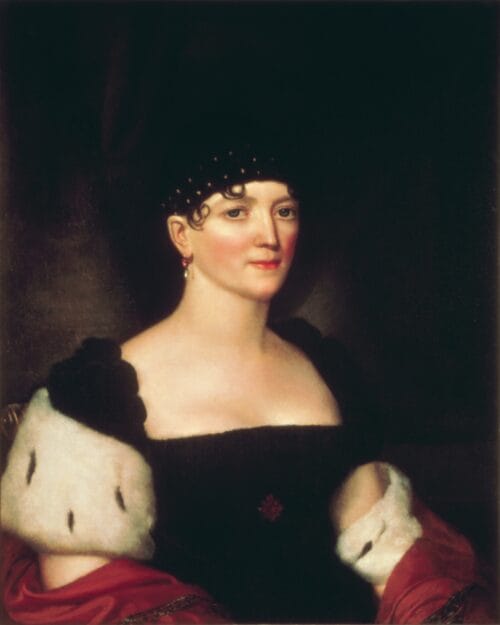
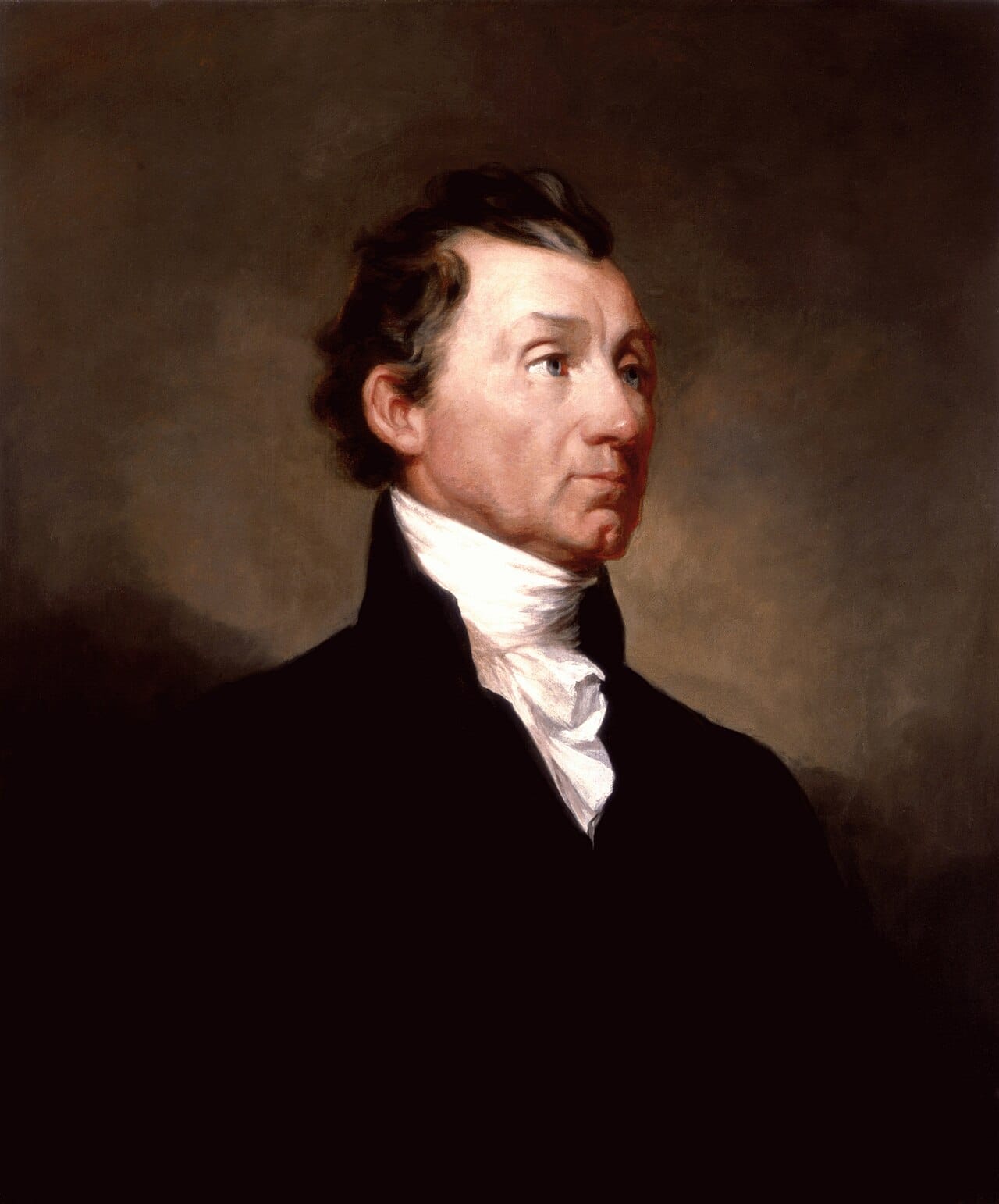
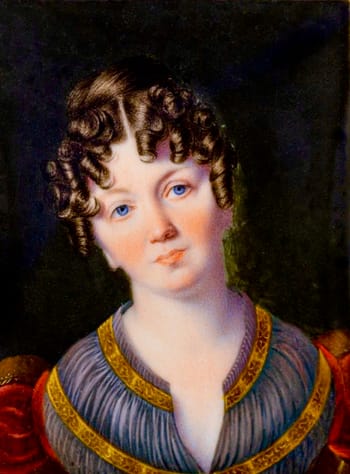
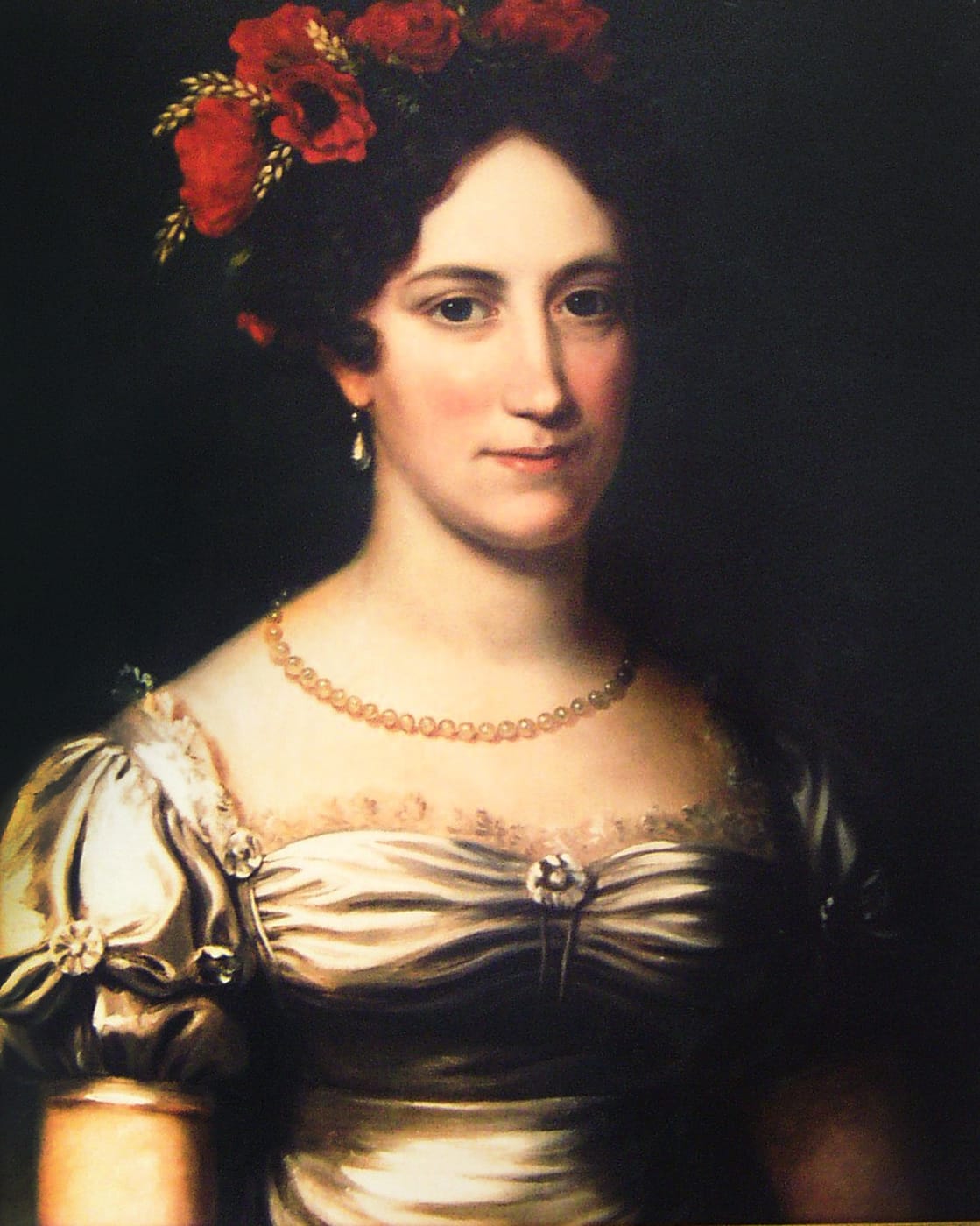
She was known in her time for more mundane things, like her beauty and her fashion choices. In that regard, I think she’s probably a lot like Jacqueline Kennedy. I’ll put portraits of Elizabeth, James, and their daughters on the webpage for this episode. There are only a couple of portraits of her, unlike Dolley Madison. Elizabeth definitely suffered reputationally from having to follow the most outgoing and best known president’s wife up to that point. But she took it in stride, apparently never striking back at the women propagating unfair gossip about her.
And she did do a lot to return a sense of dignity and grace to the President’s House, after the loosey-goosey approach of Dolley Madison. James’s first term as president was known as the Era of Good Feelings, because of the lack of partisanship and the sense of cooperation after the War of 1812. Obviously that didn’t last—not even to the end of Monroe’s presidency—but for a few years, everything in America was good, and Elizabeth Monroe was like an elegant queen, presiding over a peaceful realm.
Next season, we’re going to get to know the first president’s wife who wasn’t born in America, Louisa Adams. I think we’ll have better luck with information about her. Not only was John Quincy Adams a dedicated journal writer, but Louisa was a prolific writer too. Much like John and Abigail Adams, many of the younger Adamses' papers survived.
But before we get to Louisa Adams, I have two supplemental episodes planned. One is about a woman who was never First Lady, but whose husband was a very important Founding Father: Elizabeth Schuyler Hamilton.
The other is going to take stock of what we’ve covered so far in this podcast. We’ve reached the end of what is known as the Founding Era. James Monroe was the last Founding Father to become president. The next period of history is the Antebellum Period, the years before the Civil War. Most historians place the beginning of this period around 1812, or 1815, after the War of 1812 ended, so there’s a little bit of overlap between the Founding Era and the Antebellum Period.
But I want to bring together what we’ve learned so far and tie it all up before we move on to the next section of American history. As usual, I have no idea when any of the supplemental episodes will be released or when I will kick off Season 6. I work on the podcast continuously. While I record and edit these Season 5 episodes, I’ll be writing the supplemental episodes, and when those are done, I’ll move into the research phase for Season 6. I try not to leave long gaps between seasons, but I’m afraid that sooner or later, this podcast train is going to overtake me. But as usual, we’ll see!
Thanks for being here for Season 5! I appreciate every listener and everyone who has recommended the podcast to someone else. It’s the best way to get the word out and grow my audience. As always, this episode was produced by me, and the music is by Matt Dull. I’ll see you soon!