2000 Years of Anglo-French Relations
[Transcript]
Hello, and welcome to America’s First Ladies. I’m your host, Risa Weaver-Enion.
Season 4 Supplemental, 2000 Years of Anglo-French Relations, part I
As I mentioned at the end of season 4, I want to do a couple of supplemental episodes before we dive into Elizabeth and James Monroe. You’ve probably noticed that the contentious relationship between England and France has had a huge impact on America and the United States.
First it was the French and Indian War, known as the Seven Years’ War everywhere but in North America. Then it was the American Revolution, when France was the United States’s first official ally. Then it was the French Revolution, which bled into the Napoleonic Wars, which sparked the War of 1812. In all of these conflicts, England, or really, Britain, has been on the opposite side of France. But for those of us who have lived in the 20th and 21st centuries, we’ve only ever known England and France as allies, not opponents. You might be wondering why they were always fighting each other in centuries past. So I thought it would be fun to do a brief overview of 2000 years of history between these two countries.
I foolishly thought I could cram 2000 years into one 30-minute episode, but as I approached the word count that corresponds to about 30 minutes of audio, I was only up to about the year 1300. Then I thought I could finish in two episodes, but the Hundred Years’ War took up a lot of time. Go figure. So this will be a three-episode miniseries. Two of the episodes run a little longer than my typical episodes because there’s so much to talk about. I know this topic has nothing to do with the First Ladies, but I think it will be a fun little detour!
And before we start, just a quick note about the names of various French kings. Most historians writing in English Anglicize the names of French kings, and I’ve done the same. So Philippe becomes Philip, Henri becomes Henry, Charles becomes Charles, Jean becomes John. I’ve left Louis alone. Now let’s dive in.
You probably all know that both England and France were Roman provinces long ago. None other than Julius Caesar launched expeditions into both regions. His campaigns in what was called Gaul, across the Alps from Italy, brought him the success and acclaim that later led to him claiming the role of Dictator for Life. And in 55 BCE he was the first Roman to cross the narrow body of water separating the Isle of Britain from mainland Europe, what we today call the English Channel (and the French call La Manche, which translates literally to “the sleeve.”) At its narrowest point, only 21 miles separate the French city of Calais from the English city of Dover.
The Romans referred to the island province as Britannia, and that name was derived from the name used by the ancient Greeks to describe the island. The portion of the island north of the River Forth was called Caledonia—what we today know as Scotland. Eventually, most languages developed some derivation of Brittania to refer to the Isle of Britain.
The origin of the name Gaul is more complicated, and I really don’t want to get bogged down in minutiae this early on—we have a lot to cover. Suffice it to say that Gaul is an English-language version of Gallia, which is the Latin word used by the Romans to describe this area. Gallia was derived from a Celtic word that meant tribe. The Celtic people inhabited both Gaul and Britannia during the pre-Roman period. And that’s who the Romans eventually subdued when they made Gaul and Britannia Roman provinces.
Britannia was a Roman province for less time than Gaul was, having been brought under the Roman umbrella later than Gaul, and escaping from under that umbrella earlier than Gaul. The end of Roman rule in Britannia came mid-fifth century, around 440 CE. The Romans had always had trouble holding on to Britannia—they faced numerous revolts and usurpers over the roughly 400 years that it was a province. And as the Western Roman Empire slid into its gradual decline, Britannia extricated itself from the imperial grip.
Gaul eventually came under the control of one of the Germanic tribes from north of the Rhine River, a group known as the Franks. Again, I don’t want to get too bogged down in the details of the decline and fall of the Western Roman Empire and where the Franks came from and how they ended up taking over Gaul. But I’m sure you can hear the connection between the word Frank and the modern name of Gaul, which is France. And its historical name of Gaul or Gallia is why you still see the adjective “Gallic” used today to describe things that are French.
There’s no specific date when Gaul ceased being a Roman province. It happened over a period of years roughly from the 440s, around the time the Romans gave up on Britannia, until 481, when a Frankish leader named Clovis conquered all his enemies and was declared the king of all Franks. This was the beginning of the Merovingian dynasty, which lasted roughly until 751. Merovingian is supposedly derived from the name of Clovis’s grandfather, Merovech (mair-oh-veck).
The period from the end of Roman control in Britain, which happened around 440, until the Norman Invasion in 1066, is typically referred to as the Anglo-Saxon period. Like the Franks, the Angles and the Saxons were Germanic tribes that migrated. Britain was also invaded by migrating Jutes, a people from what is today Denmark, but their name didn’t get immortalized in the overarching name for the people inhabiting the Isle of Britain the way the Angles and the Saxons did.
The people who had inhabited Britain before the Roman conquest were called Britons (which I know sounds the same as the name of the island, but the name of the people is spelled B-R-I-T-O-N). As the Angles, Saxons, and Jutes moved in, the Britons moved west, into what is today Wales. All of them more or less co-existed on the island, but there was no unity among the various tribes or one king over all the land. Instead, there were a bunch of small territories and kingdoms, all operating independently of each other, and usually fighting against each other.
Although Christianity had become the official religion of the Roman Empire in the 300s, after the Romans left Britain, there was a mix of Christian and pagan religions on the island. The invading Germanic tribes worshipped the Norse gods, which is why the English names for the days of the week are derived from those Norse gods. In the late 500s, Pope Gregory sent a Roman missionary named Augustine to Britain. He established a monastery at Canterbury, and became the first Archbishop of Canterbury in 601. Fun fact: this year, 2026, the very first woman became Archbishop of Canterbury, a mere 1,425 years after its founding. Better late than never!
In the mid-700s, some kings started to assert control over greater areas. For example, Aethelbald of Mercia styled himself “King not only of the Mercians but of all the provinces called by the general name of Southern English.” The words “English” and “England” of course, were both derived from the Germanic tribe, the Angles. Aethelbald’s successor King Offa was the first to call himself “King of the English.” This was around the same time that Charlemagne was uniting the Frankish territory into one kingdom. More on him in a few minutes.
In fact, a dispute between Offa and Charlemagne in 789 led Charlemagne to close Frankish ports to English merchants. So we might be able to call this the starting point in the very long contentious relationship between the two countries.
In the late 700s, a new group of invaders came onto the scene. We call them Vikings, but they were actually Danes. Viking just means pirate, and is what the English called them. The invasion picked up steam in the mid-800s, and most of the 9th century was a back-and-forth between the Danes and the Anglo-Saxons. If I had unlimited time, I would go into more detail, but we still have more than 1000 years to cover.
The 10th century saw yet another new set of invaders—this time it was Norwegians coming from Ireland. The Norwegians aimed to gain control of the area ruled by the Danes, what was known as the Danelaw, and consisted of a large portion of the south and east of modern-day England. The Danes at this point were so entrenched in England, that they considered the Anglo-Saxons their allies and the Norwegians their enemies. By 954, the Norwegians had mostly been expelled from England.
But then the Viking raids started again around 980, and another important inflection point in our story took place. The Anglo-Saxon king Aethelraed made an arrangement with the Duke of Normandy, which was a territory on the western coast of the European continent. Today it’s part of France, but at this time, it was independent. Normandy had itself been invaded and taken over by Vikings a few generations earlier, and it sometimes harbored Viking raiders returning from raids in England. In 991, King Aethelraed and Duke Richard of Normandy agreed not to aid each other’s enemies, and in 1001, Aethelraed married the Duke’s daughter. You’re going to hear a lot more about the Normans and Normandy shortly.
From about 1005 until 1016, the Anglo-Saxons and the Vikings battled back and forth over English lands. The Vikings were a mix of Norwegians and Danes, so it’s easier for me to refer to them collectively as Vikings. The Danes of the Danelaw grew tired of the Anglo-Saxons, and welcomed these new conquerors to their territory, under the rule of Danish king Swein (swayne). In 1014, Swein died and his son Cnut succeeded him in the English territory. Aethelread put up a good fight, along with his son and successor Edmund Ironside, but in 1016, Cnut won a decisive battle over Edmund, and that was seemingly the end of the Anglo-Saxon kings. Cnut married Aethelraed’s widow Emma, killed or exiled Aethelraed’s surviving sons (Edmund Ironside having already died) and consolidated his power, wanting to rule England not as an invader but as a rightful English king.
And then Cnut’s dynastic line died out in 1042, making way for a return of the Anglo-Saxon kings. By that point, only one of Aethelraed’s sons was still alive; he was elected king in 1042 and was known as Edward the Confessor. And that’s going to bring us to the Norman invasion of 1066. But before we get to that, let’s go back and catch up on what happened in the Frankish territory from the sixth century to the eleventh century.
As I mentioned a few minutes ago, the Frankish territory was united under Clovis throughout the 480s and into the early 500s. Clovis converted to Catholicism in 496 at the behest of his wife, and the rest of the Franks followed suit gradually over a period of years. When Clovis died in around 513, the Franks ruled over most of what is modern France, Belgium, and a good portion of Germany.
The Merovingian period was marked by chaos and violence. It’s not even clear how many Merovingian kings there were, but 27 is a good estimate. But most of them did not rule over the entire Frankish kingdom. Instead, there were a number of minor kings and kingdoms throughout the territory.
By the eighth century, after the Merovingians had been in control of the Frankish kingdom for 200ish years, their grip on power started to slacken. As John Julius Norwich writes in A History of France, “the Merovingian kings had descended so far into dissipation and debauchery that they had effectively ceased to rule. The real power of the kingdom now rested with a distinguished head official known as the Mayor of the Palace, a post that had by now become hereditary, and was held by succeeding members of the house of Pepin.”
If you remember any names from high school world civilizations class, you may remember Charles “the Hammer” Martel, his son Pepin the Short, and Pepin’s son, Charlemagne. After Pepin the Short inherited the role of Mayor of the Palace from his father, he forced the last Merovingian king into a monastery and declared himself King of the Franks. This was the beginning of the Carolingian dynasty. When Pepin died in 768, his son Charlemagne succeeded him.
Charlemagne then greatly expanded the territory of the Franks, conquering even more of what is today Germany. Without getting bogged down in the details, in December 800, Pope Leo III crowned Charlemagne as the first Holy Roman Emperor. This cemented a stong bond between the papacy and the majority of Western Europe, which was all ruled by Charlemagne.
But after Charlemagne died in 814, things started to fall apart again. Charlemagne was succeeded by his son Louis, who is known as Louis I, the Pious. The empire was too large to reasonably rule, and it devolved into a series of civil wars between Louis and his sons. When Louis died in 840, his sons fought each other for another three years, and then divided the empire among them.
Charles the Bald received the portion of modern France that is west of the Rhône river. Louis II received what is today northeast France, Belgium, and western Germany, along with Bavaria, Swabia, and Saxony—all part of Germany today. The youngest son Lothair received land running from the North Sea through the valleys of the Meuse, Rhine, and Rhône rivers, down into Calabria in modern Italy.
This division eventually led to the increased strength of regional powers, various dukes and counts. By the time the last Carolingian king, Louis V, the Lazy, died without a legitimate heir in 987, the Carolingians were so weak that the lords of France chose a successor from outside the Carolingian family. Their selection was Hugh Capet, thus beginning what would be known as the Capetian dynasty. Although Hugh was nominally King of the Franks, he was not King of France, because the Dukes of Anjou, Aquitaine and Normandy, along with the Counts of Flanders and Blois, had as much, if not more, power than the king.
Speaking of the Duke of Normandy, let’s now talk about the Norman invasion of Britain in 1066. You’ll recall that Edward the Confessor was on the throne in 1066, but he had no heir. The only possible blood heir was the grandson of Edmund Ironside, but he was a child. The Norwegian king, Magnus, thought his heirs should inherit what had previously been Cnut’s, but surely no one else in England thought that was a good idea. The other potential candidate was Harold, son of the Earl of Wessex, who was not of royal blood, but was at least English. Edward the Confessor had spent 25 years in exile in Normandy, so he had close ties to it. It was currently ruled by Duke William, and it’s possible that Edward the Confessor intended for William to be his successor.
Long story, short: Edward died on January 5, 1066. The Norwegians invaded almost immediately, but were defeated by Harold of Wessex, who had been elected king to replace Edward. But then on September 28, the Norman army, led by Duke William, landed in England. In the Battle of Hastings on October 14, 1066, Harold was defeated and killed by the Normans, who then made quick work of subduing the rest of the major cities of southeastern England. The English nobility pledged fealty to William, and he became King of England. On Christmas Day 1066, he was crowned at Westminster Abbey, which had been designed by Norman architects at the behest of Edward the Confessor. The age of the Anglo-Saxons was now officially finished.
This kicked off a gradual replacement of English nobility and church leaders with Normans. By 1086, only two English lords remained out of what had previously been more than 4000. Their lands had been reassigned and distributed to about 200 barons, all of whom were from Continental Europe—from Brittany, Flanders, Lorraine, and Normandy most of all. After 1070, no Englishman was appointed to a bishopric or abbey.
I’m going to quote from my main source for all the English history in this miniseries, The Oxford Illustrated History of Britain. Chapter 3 by John Gillingham covers the Norman period. He writes, “[I]t is certain that by 1086 the Anglo-Saxon aristocracy was no more and its place had been taken by a new Norman elite. Naturally this elite retained its old lands on the Continent; the result was that England and Normandy, once two separate states, now became a single cross-Channel political community, sharing not only a ruling dynasty, but also a single Anglo-Norman aristocracy. Given the advantages of water transport, the Channel no more divided England from Normandy than the Thames divided Middlesex from Surrey. From now on, until 1204, the histories of England and Normandy were inextricably interwoven.
Since Normandy was a principality ruled by a duke who owed homage to the king of France this also meant that from now on ‘English’ politics became part of French politics. But the French connection went deeper still. The Normans, being Frenchmen, brought with them to England the French language and French culture.”
One of the new ties between Normandy and England was that England now found itself wrapped up in the ongoing struggles between Normandy and its traditional enemies, namely the King of France and the Count of Anjou. Anjou, like Normandy, was a province in France, and its ruler, Count Fulk, owed homage to the King of France. People from Anjou were called Angevins.
William the Conqueror ruled England, Normandy, and a smaller province called Maine until his death in 1087, but he spent most of his time on the Continent, defending Normandy from attacks by the French and Angevins. When William died, his eldest son, Robert, inherited William’s patrimonial lands, meaning the land he had inherited from his father: Normandy. Meanwhile the second eldest son, William Rufus, inherited England, the land that William had conquered. William Rufus is known as King William II.
It was less than ideal for Normandy and England to be ruled by two different people, and conflict between William Rufus and Robert was inevitable. William laid claim to Normandy in 1089, and successfully campaigned there. But he didn’t win control of Normandy until 1096, when Robert essentially leased it to him to raise funds to go on an expedition to Jerusalem and reclaim it from the Muslims. This expedition would later be known as the First Crusade.
In August 1100, when Robert was on his way back from crusade, William Rufus died, perhaps suspiciously, in a hunting accident. Within three days, his younger brother Henry had laid claim to England and was crowned on August 5. History knows him as Henry I.
A few weeks later, Robert arrived back in Normandy, which he reclaimed, now that William Rufus was dead, and then he invaded England. But the invasion didn’t accomplish much, and Robert and Henry entered into an arrangement whereby Henry would pay Robert an annual sum in exchange for maintaining his hold over England.
This detente didn’t last long though, and in 1106, Henry invaded Normandy, and took his brother prisoner, in which state he would remain until his death in 1134. Henry was now ruler of England and Normandy. But Henry had a problem: he had at least twenty illegitimate children, but his only legitimate son died in 1120, leaving just one legitimate child, a daughter named Matilda. Unlike in France, where the Salic Law prevented a woman from inheriting the throne, a woman could technically rule in England, if she could muster and maintain the support of the largest landowners, the nobility.
Henry made it clear that he intended for Matilda to succeed him, and in order to give her some male help, and also neutralize one his traditional enemies, he married Matilda to Geoffrey Plantagenet, the son of the Count of Anjou. This was way more important than it seemed at the time. The Plantagenet family (or “Plantagenette,” as it’s generally pronounced in English) would establish a dynasty that ruled England for roughly 250 years.
But there was, of course, some drama when Henry died in 1135. Matilda and Geoffrey were on the Continent, probably in Anjou, when Henry died. Henry’s nephew, Stephen of Blois, was also on the Continent, but Blois was only a day-trip away from the southern coast of England. As soon as he got word of Henry’s death, he crossed to England, secured the support of London, took control of the treasury, and had himself crowned king on December 22. He convinced all the barons who had sworn allegiance to Matilda that the oath was invalid because it had come under duress.
For the next 18 years, England was basically in a civil war, first between Stephen’s supporters and Matilda’s supporters, and then between Stephen’s supporters and those of Matilda and Geoffrey’s son, Henry.
Long story, short: Matilda invaded England and defeated Stephen in battle, but then turned down the peace terms and offended the English, who turned on her. She left England in 1148 and never returned. While she was in England, Geoffrey consolidated power in Normandy, and was formally invested as Duke of Normandy in 1144. Then in 1150, he had his and Matilda’s eldest son Henry legitimized by King Louis VII of France as the heir to Normandy. Now here’s where things get really interesting.
Geoffrey of Anjou died in 1151, making Henry Duke of Normandy and Count of Anjou in his own right. Then in 1152, King Louis VII divorced his wife, Eleanor of Aquitaine, because she had borne two daughters and no sons. Daughters were useful marriage pawns, but they couldn’t inherit the throne. Eleanor then turned around and a mere eight weeks later married young Henry Plantagenet. Aquitaine was a large French province (it’s the area of France that contains Bordeaux), and Eleanor was the Duchess of Aquitaine after inheriting from her father. So when Eleanor and Henry married each other, it combined a sizeable portion of France into one family.
In 1153, Henry invaded England, but had accomplished little when King Stephen’s son and heir Eustace suddenly died. Without an heir, Stephen was more inclined to make a deal with Henry, so it was agreed that Stephen would reign until he died, and then Henry would inherit the kingdom of England, which he claimed by way of his mother, Matilda, who had been the daughter of Henry I. It turns out that Stephen didn’t live long, dying in 1154. And so Henry Plantagenet, Duke of Normandy, Count of Anjou and Maine, husband of the Duchess of Aquitaine, became King Henry II of England.
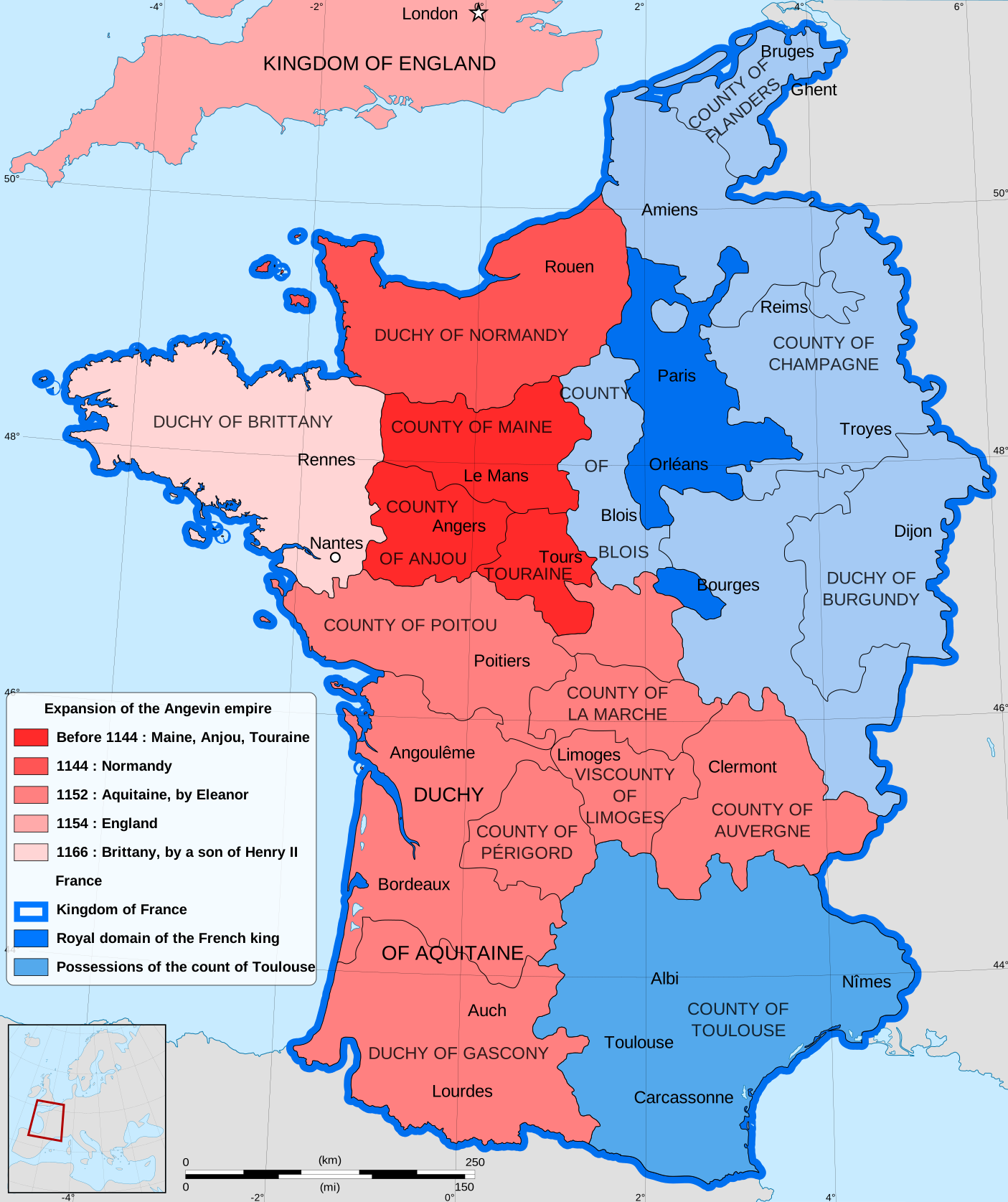
Henry was the most powerful ruler in Europe, richer than the Holy Roman Emperor, and controlling far more territory than his nominal suzerain, the king of France. I’ll put a map on the webpage for this episode so you can see how vast Henry’s Continental territories were compared to those controlled by the king of France. You can find a link in the show notes.
In addition to Normandy, Anjou, Maine, and Aquitaine, Henry also conquered the neighboring province of Brittany in 1166, and then Ireland in 1172. He ruled for 34 years, and as he got older, he naturally started thinking about the succession. In 1169, he took the unusual step of having his eldest surviving son and heir, also named Henry, crowned king. So there was the Old King Henry and the Young King Henry. But Henry and Eleanor had four sons, so in order to provide for the other three, Henry decided to split his domains. Henry the Young King would inherit Henry’s patrimony: Normandy, Anjou, and England. The second son Richard would inherit his mother’s territory of Aquitaine. The next son, Geoffrey, would inherit Britanny, where he was already invested as duke. And the youngest son, John, would inherit Ireland.
But things never go according to plan, do they? In 1180, King Louis VII of France died, putting his son Philip II on the French throne. Then Young King Henry died in 1183, and Geoffrey died in 1186. That just left Richard, who was his mother’s favorite, and John, who was his father’s favorite. In order to protect himself and his claims, Richard entered into an alliance with the new French King Philip II. When Henry II died in 1189, Richard had an unchallengeable claim to all his father’s lands, plus his mother’s lands. We know him as King Richard I, or as Sean Connery if you’re a fan of the 1991 Kevin Costner movie, Robin Hood: Prince of Thieves.
Richard had been made Duke of Aquitaine in 1172, and spent most of his time on the Continent. That didn’t change when he became King of England in 1189. And then he decided to go even further afield, joining the French King Philip II on the Third Crusade to Jerusalem, which departed in 1190. (In case you’re wondering what happened to the Second Crusade, I skipped over it because it took place from 1147 until 1149 and didn’t involve any of our English characters. But interestingly, Eleanor of Aquitaine went on that crusade with her husband at the time, Louis VII. The presence of women on crusade was largely blamed for its failure.)
Richard did not return to England until 1194, mainly because he was captured and held prisoner first in Austria and then by the Holy Roman Emperor. While he was thus detained, his brother John revolted in England, and King Philip II of France, who had returned from Crusade separately, invaded some of Richard’s Continental territories. Once Richard was released from captivity in 1194, he spent the next five years recovering everything that had been lost, but then he died from injuries sustained in a siege in April 1199.
Richard had no legitimate children when he died. There were two potential heirs, his brother John, and his nephew Arthur, who was the son of his deceased brother Geoffrey. Arthur was only 12 in 1199, and at some point prior to his death, Richard had named John his heir. So John became King John of England, but the Continental territories rejected him, preferring Arthur, who was Duke of Brittany by right of his father Geoffrey. So Arthur now became Count of Anjou, Maine, and Touraine as well. Aquitaine was held by Eleanor, who was still alive, on behalf of John.
By 1200, John had claimed all of Arthur’s territories for himself and owed homage for them to King Philip II of France. Then John married Isabella of Angoulême, who was already engaged to Hugh of Luisignan. Hugh didn’t take kindly to John stealing his fiancée, so he complained to King Philip, and Philip declared all of John’s Continental territories forfeit. No one in those territories particularly liked John, especially after he probably had his nephew Arthur killed in 1202, so they didn’t put up any resistance. Stripped of Anjou, Normandy, Maine, and Touraine, John retreated to England.
Aquitaine is more complicated. Eleanor retained it until her death in 1204, at which point it seems to have become one of John’s territories. But most historians stop referring to it as Aquitaine around this time, and start calling it Gascony. The dividing line between what is or was Gascony and what is or was Aquitaine is fuzzy. It’s all territory in southwestern France, bordered to the south by the Pyrenees mountains, to the west by the Atlantic Ocean, and to the north by the Garonne River. Aquitaine/Gascony is going to remain a point of contention between England and France for several more centuries, so for our purposes, just consider them to be the same geographical region, which includes Bordeaux and its all-important wine production.
John never stopped plotting to recover his lost Continental lands, and he raised taxes and raided church coffers to come up with necessary funds. In 1215, the barons of England forced John to agree to a number of governance reforms by signing Magna Carta. But getting him to abide by the terms of Magna Carta was a different story, and the powerful barons eventually turned to France for aid, inviting the son of Philip II, Louis, to take the English throne. Louis sailed for England and entered London in May 1216. He was even proclaimed King of England in St. Paul’s Cathedral, but he was never actually crowned. When King John died in October of that year, the English nobility transferred their allegiance to John’s heir, his nine-year-old son, Henry.
The royal council that ruled in young Henry’s name enjoyed military success against Louis’s forces. Louis gave up on England and withdrew in September 1217, leaving Henry as the unchallenged king of England. This is Henry III. Louis became King of France in 1223 when his father Philip II died, but he ruled for only three years before dying of dysentery. His twelve-year-old son Louis succeeded him as Louis IX.
Henry III started ruling in his own name in 1232. In 1259, he officially renounced his claims to Anjou, Normandy, and Maine, and he paid homage to King Louis IX of France for Gascony/Aquitaine under the terms of the Treaty of Paris. Henry III died in 1272, leaving his eldest son, Edward, as the new King of England. Edward was on his way home from crusade when he heard the news. (This was either the Eighth or the Ninth Crusade, depending on how you count. Clearly, we skipped over several.)
Edward stopped in Paris to pay homage to the French king, now Philip III, for Gascony/ Aquitaine. Edward then went to Bordeaux and spent the next year there. He would be the last English king to hold court in Bordeaux.
Next week, we’ll continue the story, and the rivalry between England and France is going to hit its apex with the Hundred Years War.
Thanks for listening to this episode. It was produced by me, and the music is by Matt Dull.