[Transcript]
Hello, and welcome to America’s First Ladies. I’m your host, Risa Weaver-Enion.
Season 5 supplemental: Elizabeth Schuyler Hamilton, Part I
As I mentioned at the end of season 5 on Elizabeth Monroe, I want to take a moment to tell you about a woman who never got to be First Lady, but whose husband was a monumentally important Founding Father: Elizabeth Schuyler Hamilton, wife of Alexander Hamilton.
I originally intended this to be one episode, but by the time I was finished writing it, it was so long, it would have been nearly an hour long. So in keeping with my goal of roughly 30-minute episodes, I’ve broken it into two episodes. I think she’s worth it.
It’s not an overstatement to say that the United States financial system owes its origins to one man. Alexander Hamilton was a financial genius. He was obviously a flawed human being as well. See his infamous affair with Maria Reynolds and his propensity for duels, which eventually got him killed.
There can be little doubt that Hamilton aspired to the presidency. It seems that every man involved in the founding of the United States wanted to be president. And maybe he could have been president if he had had a different personality. He made a lot of enemies in his quest to build the U.S. financial system, and his personal foibles were also his undoing. He was way too embroiled in scandal to ever successfully seek the presidency. But his wife deserves to be known a little better.
Once again, if you’ve seen the musical Hamilton, you’re familiar with the broad strokes of Elizabeth’s life. But obviously the musical leaves a lot out, and if you haven’t already read Ron Chernow’s biography of Alexander Hamilton, which inspired Lin-Manuel Miranda to write the musical, then a lot of nuance and references probably went right over your head. It’s a long book, but a great read. I highly recommend it, and it was my primary source for this supplemental episode.
Elizabeth Schuyler was born on August 9, 1757, in Albany, New York. She was the second child and second daughter of Philip Schuyler and Catherine Van Rensselaer. The Schuylers ultimately had 15 children, only 8 of whom survived to adulthood. The three eldest, sisters Angelica, Elizabeth, and Margarita, are featured in the musical. You know them as Angelica, Eliza, and Peggy.
Philip Schuyler’s ancestors were Dutch, having emigrated to America in 1650, when the province of New York was still New Netherland. This explains why Schuyler is pronounced the way it is, despite being spelled S-C-H-U-Y-L-E-R. Dutch pronunciation is tricky.
Both of Eliza’s parents came from well-established, wealthy families, so she grew up wealthy, and her father owned a number of slaves. So even though this story takes place in New York, we still can’t escape slavery.
She was described as strong-willed, impulsive, and a bit of a tomboy. In 1779, Tench Tilghman wrote this of her, “I was prepossessed in favor of the young Lady the moment I saw her. A Brunette with the most good natured lively dark eyes that I ever saw, which threw a beam of good temper and benevolence over her whole Countenance. Mr. Livingston informed me that I was not mistaken in my Conjecture that she was the finest tempered Girl in the World.”
Eliza’s education was on the lighter side. She had some tutoring, but never attended any formal school. It’s said that her spelling was poor, but in an age before spelling was standardized, that’s not really saying much. Even Thomas Jefferson didn’t always spell words the “proper” way. Eliza had curiosity going for her, and was always interested in politics and current affairs, which probably endeared her to her future husband.
Eliza first met Alexander Hamilton late in 1777. Hamilton was in Albany on a mission for General George Washington, and he had dinner at the Schuyler mansion while there. We don’t know what either one thought of the other upon this first meeting. At the time, Alexander was probably 22 (his birth year has been the subject of some disagreement) and Eliza was 20.
They didn’t meet again until early 1780. Eliza went to visit her Aunt Gertrude, who was staying in Morristown, New Jersey, because her husband was a doctor traveling with the Continental Army as Washington’s personal physician. Eliza befriended Martha Washington during this winter stay in Morristown.
Alexander had a reputation as a ladies’ man—he was constantly on the prowl, and turned his affections from one girl to another with lightning speed. There’s a reason why Martha Washington nicknamed her tomcat Hamilton. In January 1780, Alexander had already wooed two young ladies in quick succession, but then in February, Eliza Schuyler arrived, and things changed.
Alexander was immediately smitten with Eliza. His friend Tench Tilghman remarked, “Hamilton is a gone man.” Alexander made an excuse to visit the house where Eliza was staying every evening, and soon the entire winter camp knew that he was pursuing Eliza. Their courtship progressed quickly, and it seems that within a month, they had made plans to marry.
You won’t be at all surprised to learn that none of Eliza’s letters survive. Although she devotedly preserved everything her husband ever wrote, Eliza burned all of her own letters. So we only have Alexander’s side of their courtship to go by. Soon after reconnecting with Eliza, Alexander sent a letter to her younger sister Peggy, describing his feelings,
“I venture to tell you in confidence that by some odd contrivance or other your sister has found out the secret of interesting me in everything that concerns her. … She is most unmercifully handsome and so perverse that she has none of those pretty affectations which are the prerogatives of beauty. Her good sense is destitute of that happy mixture of vanity and ostentation which would make it conspicuous to the whole tribe of fools and foplings. … She has good nature, affability, and vivacity unembellished with that charming frivolousness which is justly deemed one of the principal accomplishments of a belle. In short, she is so strange a creature that she possesses all the beauties, virtues, and graces of her sex without any of those amiable defects which…are esteemed by connoisseurs necessary shades in the character of a fine woman.”
By April 1780, Eliza and Alexander were officially engaged, with her father’s blessing. It turned out that Eliza was the only one of Philip Schuyler’s five daughters who sought his permission to marry. The other four all eloped, with one actually climbing down a rope ladder to run off with her beloved.
Speaking of Eliza’s sisters, we should address the elephant in the room, namely, Alexander’s relationship with Eliza’s older sister, Angelica. She was already married by the time Alexander came into the Schuyler family’s sphere, but it seems likely that Hamilton would have married Angelica rather than Eliza if Angelica had been available. Ron Chernow writes,
“Together, the two eldest sisters formed a composite portrait of Hamilton’s ideal woman, each appealing to a different facet of his personality. Eliza reflected Hamilton’s earnest sense of purpose, determination, and moral rectitude, while Angelica exhibited his worldly side—the wit, charm, and vivacity that so delighted people in social intercourse.
The attraction between Hamilton and Angelica was so potent and obvious that many people assumed they were lovers. At the very least, theirs was a friendship of unusual ardor…For the next twenty-four years, Angelica expressed open fondness for Hamilton in virtually every letter that she sent to her sister or to Hamilton himself. Hamilton always wrote to her in a buoyant, flirtatious tone. … It is hard to escape the impression that Hamilton’s married life was sometimes a curious ménage a trois with two sisters who were only one year apart. … Their shared love for Hamilton seemed to deepen their sisterly bond. Ironically, Eliza’s special attachment to Angelica gave Hamilton a cover for expressing affection for Angelica that would certainly have been forbidden with other women.”
It’s unknown whether Alexander and Angelica’s relationship ever crossed the line and became sexual. We know from the Maria Reynolds affair that Hamilton was unfaithful to Eliza, so it’s not completely far-fetched. But I’d like to think that Angelica, at least, would not have crossed that line and betrayed her dear sister that way.
So, with that out of the way, let’s get back to Eliza and Alexander. They didn’t actually marry until December 14, 1780, because Alexander was busy with his military service during the campaigning season of 1780. They were married at the Schuyler mansion in Albany and then took a short honeymoon to Eliza’s childhood home, known as the Pastures.
Although the Schuyler family was wealthy, Alexander did not intend to live off their money. In one of the many letters he sent to Eliza during their engagement he wrote, “Tell me, my pretty damsel, have you made up your mind upon the subject of housekeeping? Do you soberly relish the pleasure of being a poor man’s wife? Have you learned to think a homespun preferable to a brocade and the rumbling of a wagon wheel to the musical rattling of a coach and six?”
But there can be no doubt that Eliza was prepared to make any sacrifice to be with Alexander. She loved him completely and was so devoted to him, she spent 50 years as a widow after his death, never remarrying and working tirelessly to preserve his papers, reputation, and legacy. She didn’t care if he had money or not. She just wanted to be with him.
The guest list at Eliza and Alexander’s wedding was alarmingly skewed. His mother was dead, he was estranged from his father, and his brother lived in the Caribbean and did not attend. Most of his friends were in the Continental Army, and they were too busy with official duties to attend. So the wedding at the Schuyler mansion was entirely a Schuyler family affair. Fortunately, they had a massive extended family, so there were plenty of people in attendance. There’s no report on what Eliza wore for her wedding.
After spending the Christmas holidays together, Alexander and Eliza were apart for a short time when he returned to military service in January 1781, but Eliza soon joined him in New Windsor, and helped Martha Washington arrange entertainments for the officers that winter.
A short while later, Hamilton and Washington had their famous falling-out, and the Hamiltons left the army’s winter encampment, but they didn’t go far, nor did Alexander stop his efforts to influence the direction of the developing country. In April, he sent a 31-page letter to Robert Morris, recently named superintendent of finance, outlining his fully thought-through plan for shoring up American credit and creating a national bank. Eliza clearly served as scribe for part of the letter, because portions of it are in her handwriting, with her typical misspellings.
Soon after this, Eliza returned to her parents’ home in Albany, probably because she was pregnant with their first child. Alexander remained on duty with the army and played an important role in the Battle of Yorktown, in October 1781, after which he immediately raced to Albany to be with Eliza. She gave birth to their first child, a boy, on January 22, 1782. They named him Philip in honor of Eliza’s father.
The Hamiltons remained in Albany for most of 1782, until Alexander left to join the Confederation Congress in Philadelphia in November that year. Eliza and Philip remained in Albany, but the small family of three moved together to New York City in November 1783. Alexander went into private practice as an attorney, while Eliza focused on their home and young Philip. On September 25, 1784, she gave birth to their second child, a girl they named Angelica in honor of Eliza’s sister.
Much like Patty Jefferson, Eliza Hamilton spent the majority of her marriage either pregnant or nursing a newborn child. She and Alexander would ultimately have eight children in 20 years. Remarkably, they all lived to adulthood.
Their third child, Alexander Jr., was born May 16, 1786, and then the following year, they took in Fanny Antill, the orphaned daughter of one of Hamilton’s war colleagues. She lived with them from the age of two until she was twelve, when she went to live with her older married sister. This was a characteristic display of Eliza’s generosity and warm heart, especially when it came to children. Later, after Hamilton’s death, Eliza co-founded New York’s Orphan Asylum Society, where she served in various roles, including its president, for 42 years. Ron Chernow writes, “That Eliza married one orphan, adopted another, and cofounded an orphanage points up a special compassion for abandoned children that might explain, beyond his obvious merits, her initial attraction to Hamilton.” Her sister Angelica wrote to Alexander from London after hearing about Fanny, “All the graces you have been pleased to adorn me with fade before the generous and benevolent action of my sister in taking the orphan…under her protection.”
On April 14, 1788, Eliza gave birth to their fourth child, another boy, whom they named James Alexander. James was the name of Hamilton’s brother and father. In addition to raising her children, Eliza also had a number of other talents. According to Ron Chernow, she made handbags and pot holders, wove table mats, arranged flowers, designed furniture, and did all the usual sewing and cooking that women of this time period undertook.
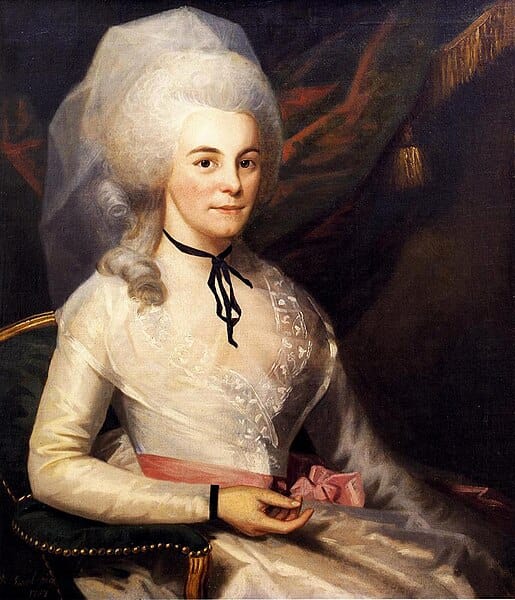
In between all this child-bearing, Eliza also made time to do benevolent acts for friends in need. In 1786, a painter friend of theirs named Ralph Earl was put in debtors’ prison. In order to help him, Eliza went to the prison to have her portrait painted by him, and then convinced other ladies to do so as well. Their payments to him helped him pay off his debts and be released from prison. I’ll put the portrait on the webpage for this episode. You can find the link in the show notes.
Eliza and Alexander were also frequent theater attendees, and regular guests at the home of John and Sarah Jay. They also hosted guests at their Wall Street home regularly, and Eliza was known for putting together elegant meals full of fresh produce shipped down to them by her family upstate.
Eliza was raised in the Dutch Reformed Church, a Protestant religion in the Calvinist tradition, and she remained deeply religious her entire life. Her son James later recalled a typical morning at the Hamilton household: “[She was] seated, as was her wont, at the head of the table with a napkin in her lap, cutting slices of bread and spreading them with butter for the younger boys, who, standing at her side, read in turn a chapter in the Bible or a portion of Goldsmith’s Rome. When the lessons were finished, the father and elder children were called to breakfast, after which the boys were packed off to school.” Naturally, the girls were educated at home.
Oh, and to get caught in the weeds for a minute here, his reference to Goldsmith’s Rome is Oliver Goldsmith’s History of Rome, which was first published in 1808. Since Hamilton died in 1804, the children couldn’t have been reading from this book before their father was called to breakfast. But in James’s defense, he wrote this description well after the fact, in 1869, so he must have been conflating scenes from different years.
Eliza had her three eldest children baptized at Trinity Church in New York in October 1788. Church-going was not something she shared with her husband. He had been rather devout as a young man, but had fallen out of the habit of attending church services.
Eliza’s religion did not prevent her from having fun. She and Alexander attended the ball held in honor of George Washington’s inauguration as the first President of the United States, and she danced with the president. They attended many balls and parties, and were a fixture of the New York social scene. Later in life, Eliza reminisced that she had “little of private life in those days.”
As we know, Hamilton served as Secretary of the Treasury in the Washington Administration, and quite nearly worked himself to death while doing it. He was a one-man powerhouse, trying to establish a financial system for a new country. The work consumed him, and for long periods of time, he was alone in New York City with his work while Eliza and the children were in Albany at her parents’ house. But Eliza was in New York City often enough to be a regular guest at Martha Washington’s drawing room receptions, and Alexander sometimes kept one or two of the older boys with him in the city when Eliza and the younger children went to Albany.
Eliza and Alexander shared responsibility for educating their children, but the bulk of it fell to Eliza when the children were younger. In 1791, 9-year-old Philip and 6-year old Alexander Jr. went to boarding school in Trenton. Young Angelica and James continued to be educated at home.
After the capital of the country relocated to Philadelphia in 1790, Hamilton purchased a home that was only one block from his offices at the Treasury Department. Eliza and the children were sometimes in Philadelphia with him, and sometimes in Albany. But when she was in Philadelphia, she was clearly a source of great support for her husband. In early 1791, there was a bitter fight over the establishment of a national bank. We don’t have time for the details, but Alexander drafted a 15,000-word treatise defending the bank, and Eliza later recalled the furious pace at which he worked on it as the deadline approached. The quote was written by the young man she was recounting the story to, so the phrasing is a little odd:
“I told her how greatly I was interested…on account of her husband’s connection with the government. ‘He made your government’ said she. ‘He made your bank. I sat up all night with him to help him do it. Jefferson thought we ought not to have a bank and President Washington thought so. But my husband said, “We must have a Bank.” I sat up all night, copied out his writing, and the next morning, he carried it to President Washington and we had a bank.’”
By the summer of 1791, Eliza was feeling a little overwhelmed by the Philadelphia social scene (and perhaps exhausted from staying up all night helping Alexander with his prodigious work), so she and the children went to spend the summer with her parents in Albany. And this is when Alexander became embroiled in the infamous Maria Reynolds affair. We discussed some of this last season, but if you want a full account of the affair, I’ll direct you to Chapter Nineteen of Ron Chernow’s biography, titled Alexander Hamilton.
For our purposes in this episode about Eliza, we’ll limit ourselves to her side of things. Throughout the summer, as Alexander carried on his affair with Maria, he encouraged Eliza to remain in Albany for her health. Whenever she wrote that she was considering returning, he would urge her to stay: “I am so anxious for a perfect restoration of your health that I am willing to make a great sacrifice for it.”
It would be easy to be cynical about his stance, but he later wrote that his biggest fear was that Eliza would return to Philadelphia and Maria’s husband might accost her with the truth, which would be extremely hurtful to Eliza. “No man tender of the happiness of an excellent wife could, without extreme pain, look forward to the affliction which she might endure from the disclosure…of the fact. … The truth was that…I dreaded extremely a disclosure—and was willing to make large sacrifices to avoid it.”
Here’s a tip, Alexander: if you want to spare your wife pain, maybe just don’t have an affair in the first place.
When Eliza and the children returned to Philadelphia in the autumn of 1791, Alexander continued with the affair, but his trysts with Maria had to take place at her house, rather than his. In the end, Eliza did not find out about the affair until Alexander published his confession in 1797.
In the meantime, their marriage continued as usual, and Eliza gave birth to their fifth child, a boy named John Church, on August 22, 1792. Jumping ahead to 1793, it won’t surprise you to hear that the Hamilton family was caught up in the great yellow fever epidemic of that year. Alexander was the first to come down with the disease. The family decamped to their summer house, which was about two and half miles outside of town. Alexander and Eliza stayed in the main house, while the children were sequestered in the adjoining house. Soon, Eliza was also sick.
The Hamiltons were saved by a lucky turn of events. An old friend of Alexander’s from his youth in St. Croix, was a doctor who had recently moved to Philadelphia. He did not believe in the usual treatment of leeches and purges, amazingly enough, and he treated the Hamiltons with actual medicine, including large doses of quinine from the cinchona tree bark, which was also a treatment for malaria, another mosquito-borne illness. (But remember, at this time, they didn’t know yellow fever was transmitted by mosquitos, so Dr. Stevens was either incredibly lucky or incredibly prescient in using quinine to treat it.)
Lest we compliment Dr. Stevens too highly, he did also treat them with copious amounts of brandy topped with burned cinnamon and nightly tinctures of opium, called laudanum in those days. And he was something of an herbalist as well, giving them a blend of chamomile, peppermint oil, and lavender to stop the vomiting. But in the end, his approach yielded miraculous results, curing the Hamiltons within five days. The family then spent some time at the Schuyler mansion in Albany to enjoy the fresh air and fully recuperate from their brush with death.
The French Revolution afforded Eliza another opportunity to display her benevolence. As impoverished emigrés arrived in America, she donated and helped raise money to support them. In addition to monetary support, she also sent bundles of food and clothing to French widows who had brought their children with them to Philadelphia.
And here’s a little fun fact for you: before he eventually became Emperor Napoleon’s foreign minister, Charles-Maurice de Talleyrand-Perigord, our old friend Talleyrand, was a French refugee in Philadelphia. He had known Eliza’s sister Angelica in Europe, and she connected Talleyrand with the Hamiltons. Eliza later described him in less than flattering terms, “He was notoriously misshapen, lame in one foot, his manners far from elegant, the tone of his voice was disagreeable, and in dress he was slovenly.” Eliza clearly pulled no punches in her old age.
In the summer of 1794, both Eliza and two-year-old John became ill. No one says what ailed young Johnny, but it seems that Eliza was literally sick with worry over the boy’s condition. Alexander took an extremely rare break from work to accompany them to Albany and to nurse them back to health. Eliza was pregnant at the time, and Alexander was almost certainly feeling guilty about his affair with Maria Reynolds.
He couldn’t stay with them as long as he would have liked, because the Whiskey Rebellion was unfolding in Western Pennsylvania, and he had a mountain of work to attend to in Philadelphia. He gave Eliza detailed instructions via letter as to how to treat young Johnny when his condition improved. The treatment included laudanum and limewater, but if that didn’t work, a cold bath and brandy. Interesting approach, but at least it wasn’t leeches! Amazingly, whatever they were doing worked, and little Johnny recovered. Sadly, Eliza suffered a miscarriage later that year.
Immediately after these family health scares, Alexander decided to resign from government service and return to private law practice in New York. This decision was also probably driven by the fact that the Hamiltons were all but broke and heavily in debt. Alexander could earn far more as a private attorney than the $3500 salary he earned as Treasury Secretary (which is about $93,000 in today’s money).
Eliza and the children mostly lived in Albany, with Alexander dividing his time between Albany and New York City. She doesn’t surface much in the historical record over the next couple of years. When President Washington was preparing to finally leave the presidency, Alexander drafted his Farewell Address, and Eliza helped him with it by listening to him read portions aloud as he worked, to see if it sounded okay. Her next mention in the history books is when she gave some fashion advice to her sister Angelica, who was finally returning to New York with her husband, John Church, after many years in Europe.
And this is a good place to leave off for this week, because we’re about to find ourselves embroiled in the public scandal that is the Maria Reynolds Affair. Next week, we’ll pick up right here and follow Eliza until the end of her life.
Thanks for listening to this episode. It was produced by me, and the music is by Matt Dull.